TOP-TIER TRAVEL中/EN

Germany

10 hidden gems in Germany

Castles, old towns & river valleys. We picked 10 places in this region — some well known, some few visitors find. Browse at your own pace, then take the quiz when something catches your eye.

TOP-TIER TRAVEL › All hidden gems › Germany

Not sure which to pick? Take the 4-minute travel-personality quiz and find the one that suits you.

Take the quiz
Regensburg
First time? Start with Berlin and Munich

Berlin's Brandenburg Gate and Museum Island, Munich's Marienplatz and beer halls — do these classics first and you can't go wrong. Germany's ICE high-speed trains link the big cities; Berlin to Munich takes about 4 hours at the fastest. Then save two or three days for the place below that's truly yours.

Looking for a place to stay in this area? Start here:

Spot details checked: October 2026

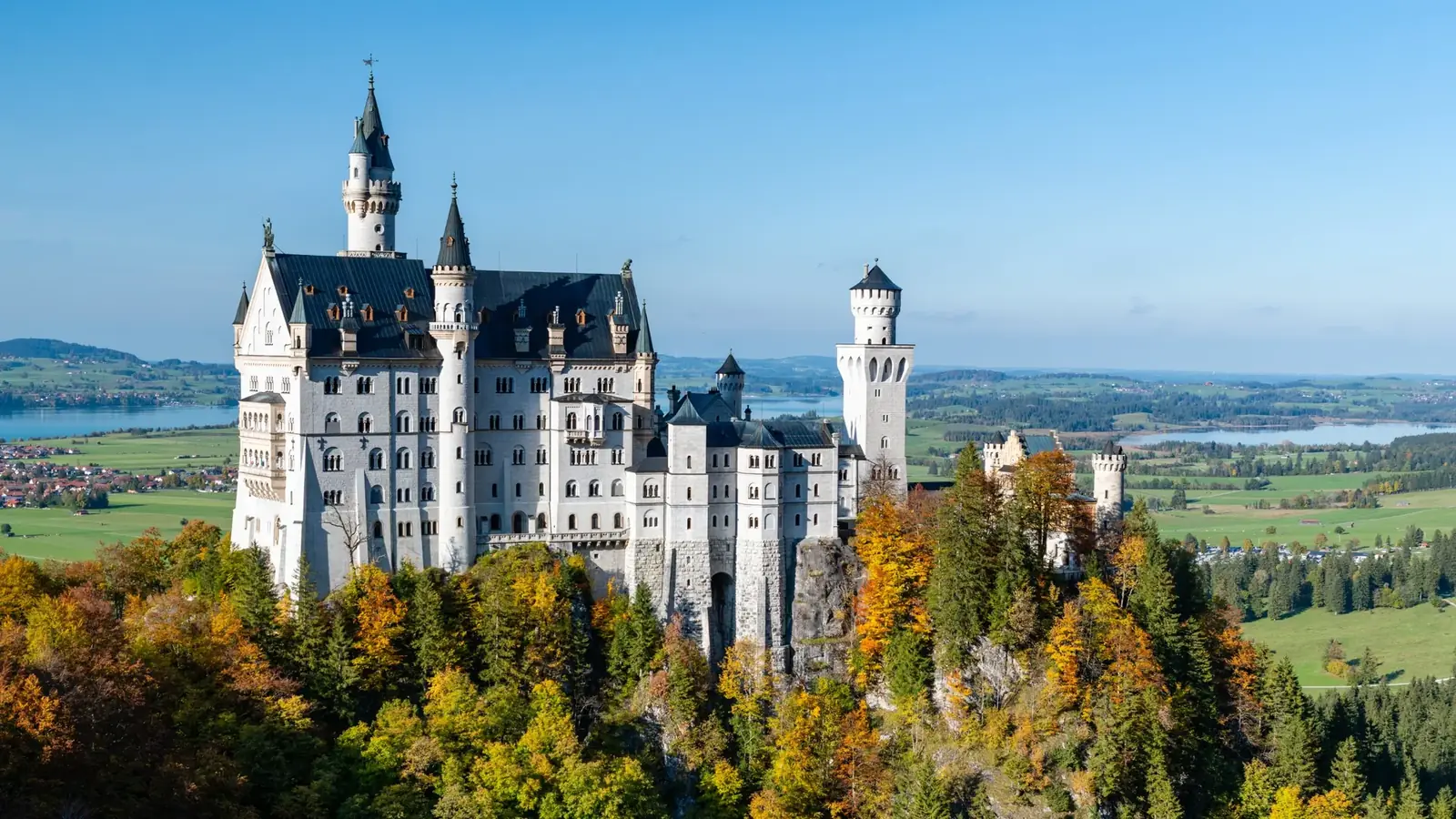
Neuschwanstein in autumn, with the lakes belowNear Füssen, Bavaria

Neuschwanstein in autumn, with the lakes belowChristoph Strässler / CC BY-SA 2.0

Neuschwanstein Castle

The fairy-tale white castle really does sit on a cliff.

Getting there●●●○○Doable on your own: about 2 hours by train from Munich to Füssen, a 10-minute bus, then a 30–40 minute uphill walk. Book castle tours online in advance.

Best timeMay–Oct

Many people come to Germany just to see Neuschwanstein with their own eyes.

A white castle stands on a cliff, wrapped in forest, with lakes and a wide plain beyond. King Ludwig II of Bavaria began building Neuschwanstein in 1869. Obsessed since childhood with medieval legends of knights and with Wagner's operas, he poured those dreams into stone. The king died mysteriously in 1886 before it was finished, having lived in it for fewer than 200 days. The castle is often said to be one of the inspirations for Disney's Sleeping Beauty Castle. The interior can only be seen on a guided tour, and photos aren't allowed inside; for the classic view of the whole castle, walk to Marienbrücke, the bridge spanning the gorge nearby.
GETTING THEREFrom Munich Hauptbahnhof, take the regional train to Füssen (about 2 hours), then the bus to Hohenschwangau village (about 10 minutes), and walk uphill for 30–40 minutes. Shuttle buses and horse carriages also run, but there are often queues. Castle tours must be booked online for a time slot in advance; very few tickets are sold on the day.
GOOD TO KNOWGolden October forests and the castle under winter snow are the most fairy-tale moments, and Marienbrücke is quietest early in the morning. Timed entry is strict — arrive late and you may be turned away, so allow time for the walk up. The bridge closes for ice, snow or repairs; check official notices before you go.
SAFETYPart of the path up is steep and gets icy in winter. Don't push on Marienbrücke when it's crowded.
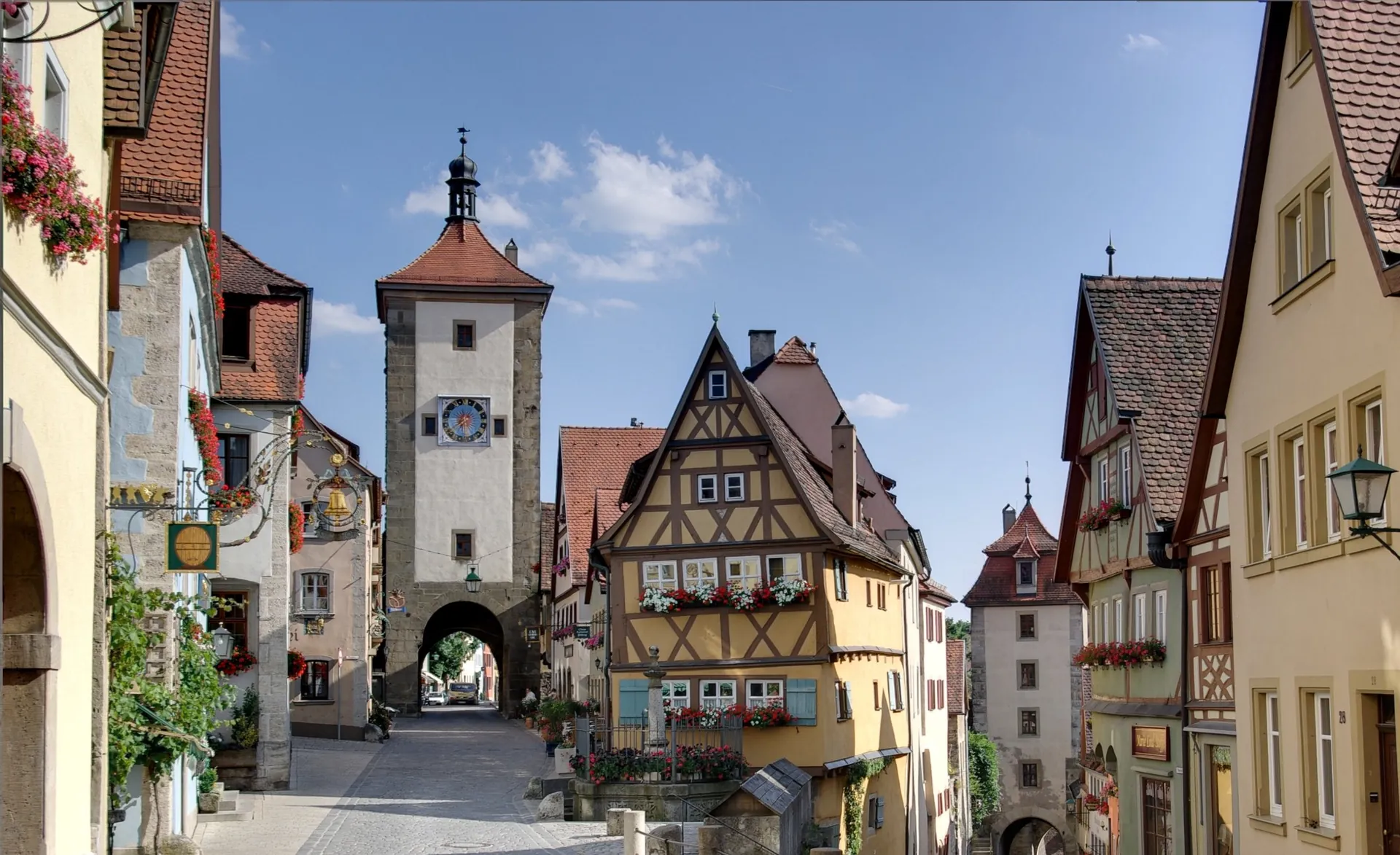
Rothenburg's Plönlein cornerTauber valley, Bavaria

Rothenburg's Plönlein cornerBerthold Werner / Public domain

Rothenburg ob der Tauber

A yellow half-timbered house between two towers — like stepping into a picture book.

Getting there●●●○○Doable on your own: just over 1 hour by train from Würzburg or Nuremberg, with a change on the way.

Best timeMay–Sep, Dec

For Germany's most storybook medieval town, go to Rothenburg.

A yellow half-timbered house stands where the road forks: a tall tower on the left, and on the right a cobbled lane sloping down to another gate. This little square, the Plönlein, is the corner of Rothenburg you'll find on every postcard. The full name is Rothenburg ob der Tauber — Rothenburg above the Tauber — and the old town is still completely enclosed by its medieval walls. A roofed walkway runs along a long stretch of them, looking out over a sea of red roofs. In the evening you can join the Night Watchman's tour, following his lantern around the old town while he tells its stories; English tours are available. Day-trippers crowd in by day — stay the night, and Rothenburg's mornings and evenings are yours.

GETTING THEREFrom Würzburg, just over 1 hour by train with a change at Steinach; from Nuremberg about 1.5 hours with one or two changes. The old town is a 10–15 minute walk from the station. Check the official site for Night Watchman tour seasons and times.
GOOD TO KNOWDecember's Christmas market is the most storybook time, and early mornings and evenings, when day-trippers have gone, are best for photos. People live here — don't go into private courtyards, and don't lean on doorways or windowsills. Parts of the wall walk are narrow and low, so mind your head.
SAFETYThe cobbles are uneven and slippery in the rain. Some stretches of the wall walk have low railings — hold on to children.
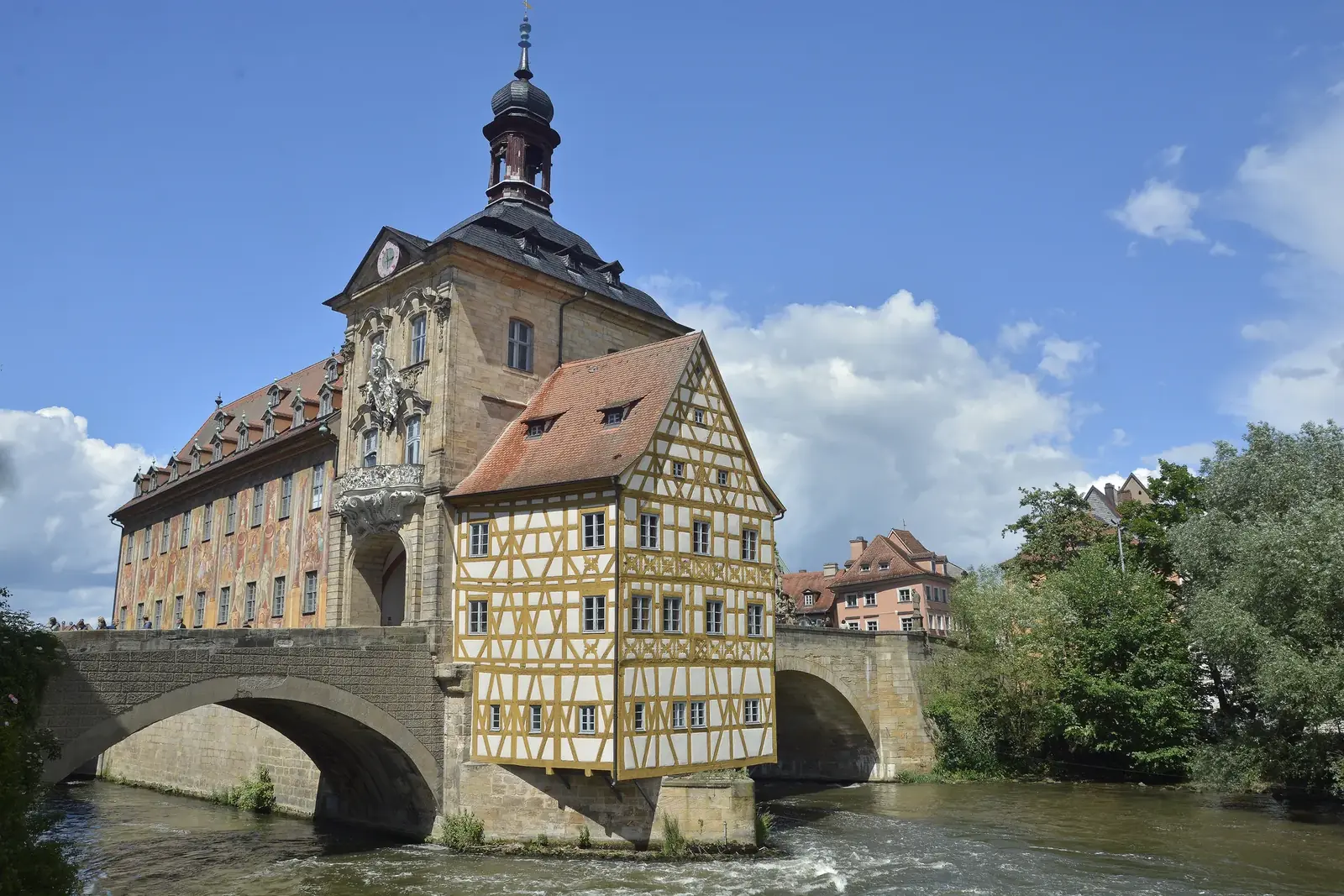
Bamberg's Old Town Hall on the RegnitzUpper Franconia, Bavaria

Bamberg's Old Town Hall on the RegnitzGuido Radig / CC BY 4.0

Bamberg

A town hall built in the middle of the river, bridged to both banks.

Getting there●●○○○Easy on your own: 30 minutes to 1 hour by train from Nuremberg; the old town is about 20 minutes' walk from the station.

Best timeGood all year

For a beer that tastes of smoked ham, go to Bamberg.

Bamberg's town hall sits on a little island in the middle of the Regnitz, joined to both banks by bridges, its walls covered in colourful frescoes and a half-timbered cottage hanging out over the water. Legend says the bishop refused to give the townspeople land for a town hall, so they drove stakes into the river and built their own island. Bamberg came through the Second World War almost undamaged, and its whole old town is a World Heritage site. Walk along the river to see a row of old fishermen's houses right at the water's edge — the area is called Little Venice. Bamberg is best known for Rauchbier, smoked beer: the malt is smoked over wood, giving it a taste like smoked ham. The first sip may surprise you; by the second glass you'll get it.

GETTING THERE30 minutes to 1 hour by train from Nuremberg; about 2 hours from Munich. The old town is about 20 minutes on foot from the station, or take a city bus.
GOOD TO KNOWEvening, when the old town hall over the river lights up, is the most atmospheric — perfect with a smoked beer. The bridges are everyday routes for locals, so don't block them for photos. Rauchbier is an acquired taste; start with a small glass.
SAFETYSome riverbanks have no railings and the current is faster than it looks — don't sit on the low riverside walls.
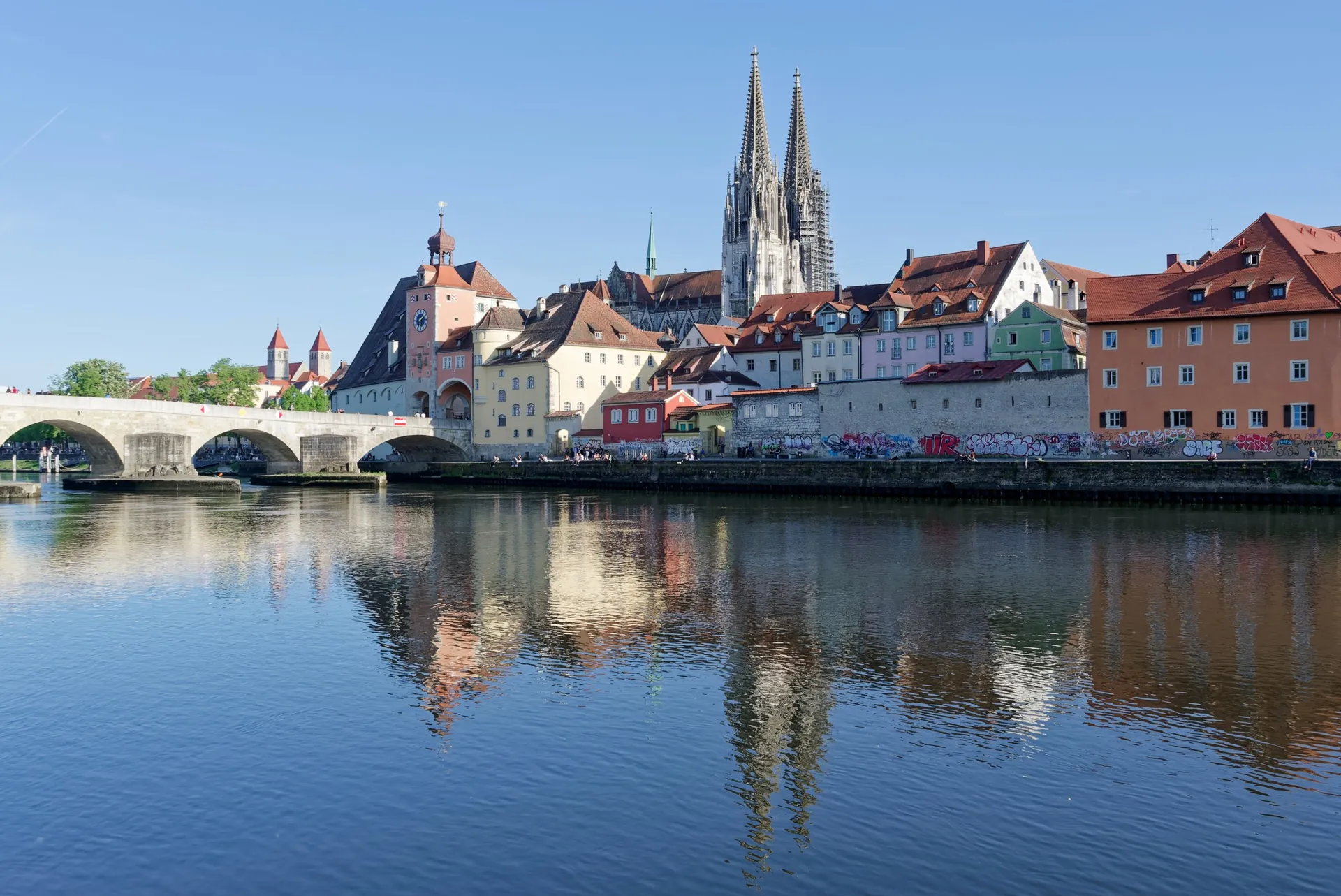
Regensburg Cathedral and the Stone Bridge on the DanubeOn the Danube, Bavaria

Regensburg Cathedral and the Stone Bridge on the DanubeJakub Hałun / CC BY 4.0

Regensburg

A stone bridge nearly 900 years old, leading into the old town below a twin-spired cathedral.

Getting there●●○○○Easy on your own: about 1.5 hours by train from Munich, about 1 hour from Nuremberg.

Best timeGood all year

For one of Germany's best-preserved medieval old towns, go to Regensburg.

A stone bridge crosses the Danube, and behind the old gate at its end, the cathedral's twin spires shoot straight up. The bridge was finished in the 12th century — one of the oldest surviving stone bridges in Germany and an engineering marvel in its day. Regensburg's old town was barely bombed in the Second World War, so its medieval houses and towers still stand in large numbers; it became a World Heritage site in 2006. The Gothic St. Peter's Cathedral took centuries to build, and its two spires weren't finished until the 19th century. When you need a break, have grilled little sausages with sauerkraut by the river; on summer evenings the riverbank fills with locals soaking up the sun.

GETTING THEREAbout 1.5 hours by train from Munich and about 1 hour from Nuremberg; the old town is about 10 minutes' walk from the station. In summer you can take a Danube boat trip — check the official site for schedules.
GOOD TO KNOWSummer evenings by the Danube, looking at the stone bridge and cathedral spires, are the nicest; December brings Christmas markets. The cathedral is in use, so don't tour or take photos during Mass. The bridge is busy — don't block it.
SAFETYMost of the riverside path has no railings — keep away from the edge at night if you've been drinking.
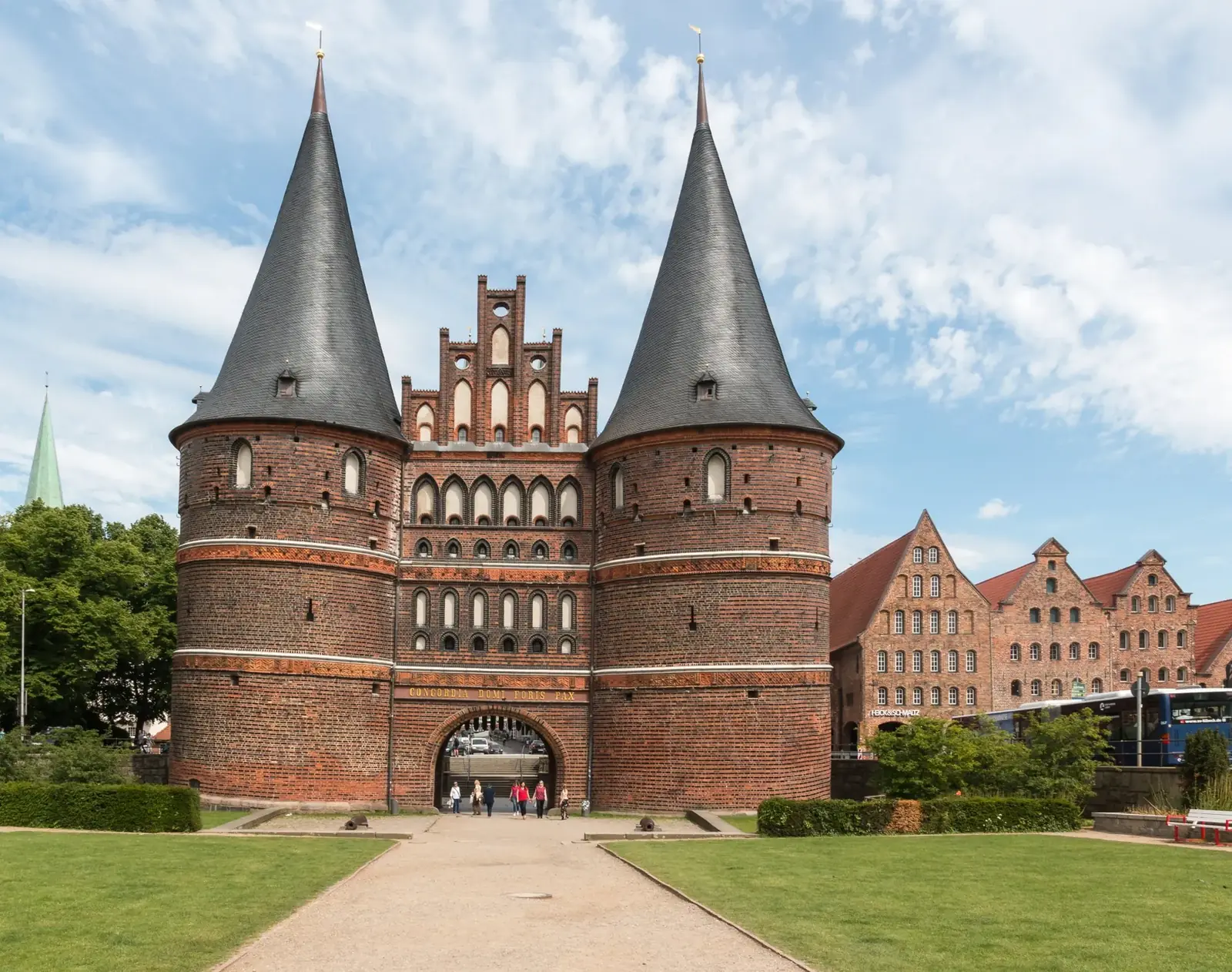
Lübeck's Holstentor and the old salt warehouses beside itSchleswig-Holstein

Lübeck's Holstentor and the old salt warehouses beside itDietmar Rabich / Wikimedia Commons / “Lübeck, Holstentor -- 2017 -- 0301” / CC BY-SA 4.0 / cropped (edited by TOP-TIER THINKING)

Lübeck

Guarded by two cone-capped towers: the one-time Queen of the Hanseatic League.

Getting there●○○○○Very easy on your own: about 45 minutes by train from Hamburg; the Holstentor is 5 minutes' walk from the station.

Best timeGood all year

Less than an hour from Hamburg is the red-brick old town of Lübeck.

Two round towers wearing black pointed caps, with a red-brick gate between them: this is Lübeck's Holstentor, completed in the 15th century, with a Latin inscription meaning “Harmony within, peace abroad”. Look closely and you'll notice the towers lean slightly — the ground is soft, and the gate slowly sank after it was built. In the Middle Ages Lübeck led the Hanseatic League and was known as the Queen of the Hanse, growing rich on salt and sea trade; the row of brick buildings next to the gate are its old salt warehouses. The whole old town is an island ringed by water and became a World Heritage site in 1987. Lübeck is also famous for marzipan — take a piece home.

GETTING THEREAbout 45 minutes by regional train from Hamburg Hauptbahnhof; the Holstentor is about 5 minutes' walk from the station, and the old town is easy to see on foot.
GOOD TO KNOWIt's loveliest at the December Christmas markets — a great time to buy marzipan — and the Holstentor looks wonderful lit at dusk. Most churches are in use, so don't tour during Mass. Check the Holstentor museum's opening hours on the official site.
SAFETYThe old town's cobbles are uneven and slippery in the rain. The road in front of the gate is busy — use the crossings.
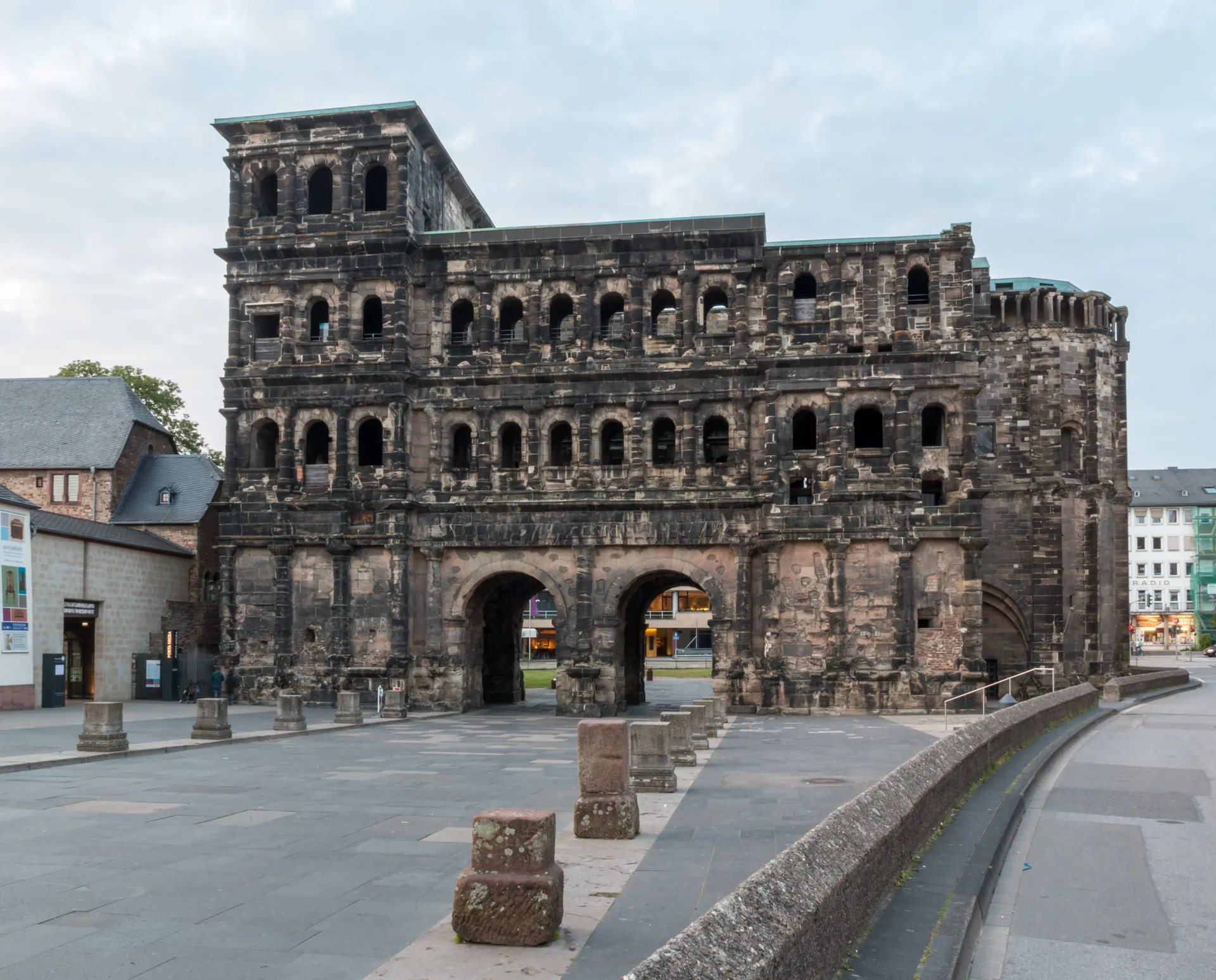
Trier's Roman city gate, the Porta NigraOn the Moselle, Rhineland-Palatinate

Trier's Roman city gate, the Porta NigraDietmar Rabich / Wikimedia Commons / “Trier, Porta Nigra -- 2015 -- 6123” / CC BY-SA 4.0

Trier

A Roman gate nearly 2,000 years old, blackened by time.

Getting there●●○○○Easy on your own: 45 minutes to 1 hour by train from Luxembourg, about 3 hours from Frankfurt.

Best timeGood all year

To see what the Roman Empire left behind in Germany, go to Trier.

A gate of huge sandstone blocks, darkened by nearly two thousand years of weather — hence its name, Porta Nigra, the Black Gate. The Romans built it in the 2nd century AD, and it is the best-preserved Roman city gate north of the Alps. In the Middle Ages a monk moved in to live as a hermit, and the gate was later turned into a church; only under Napoleon were the church additions removed and the gate restored. Trier is often called Germany's oldest city, and it also has Roman imperial baths, the Basilica of Constantine and an amphitheatre — together a World Heritage site since 1986. You can buy a ticket to go up inside the Porta Nigra and look out over the old town square from its windows.

GETTING THERE45 minutes to 1 hour by train from Luxembourg; about 1.5 hours from Koblenz; about 3 hours from Frankfurt with a change. The Porta Nigra is about 10 minutes' walk from the station.
GOOD TO KNOWSpring to autumn, in good weather, is the best time to cover the scattered Roman sites. Many charge separately — check opening hours on the official site. The stairs inside Porta Nigra are narrow and steep.
SAFETYThe stone steps inside the gate are worn smooth — hold the rail.
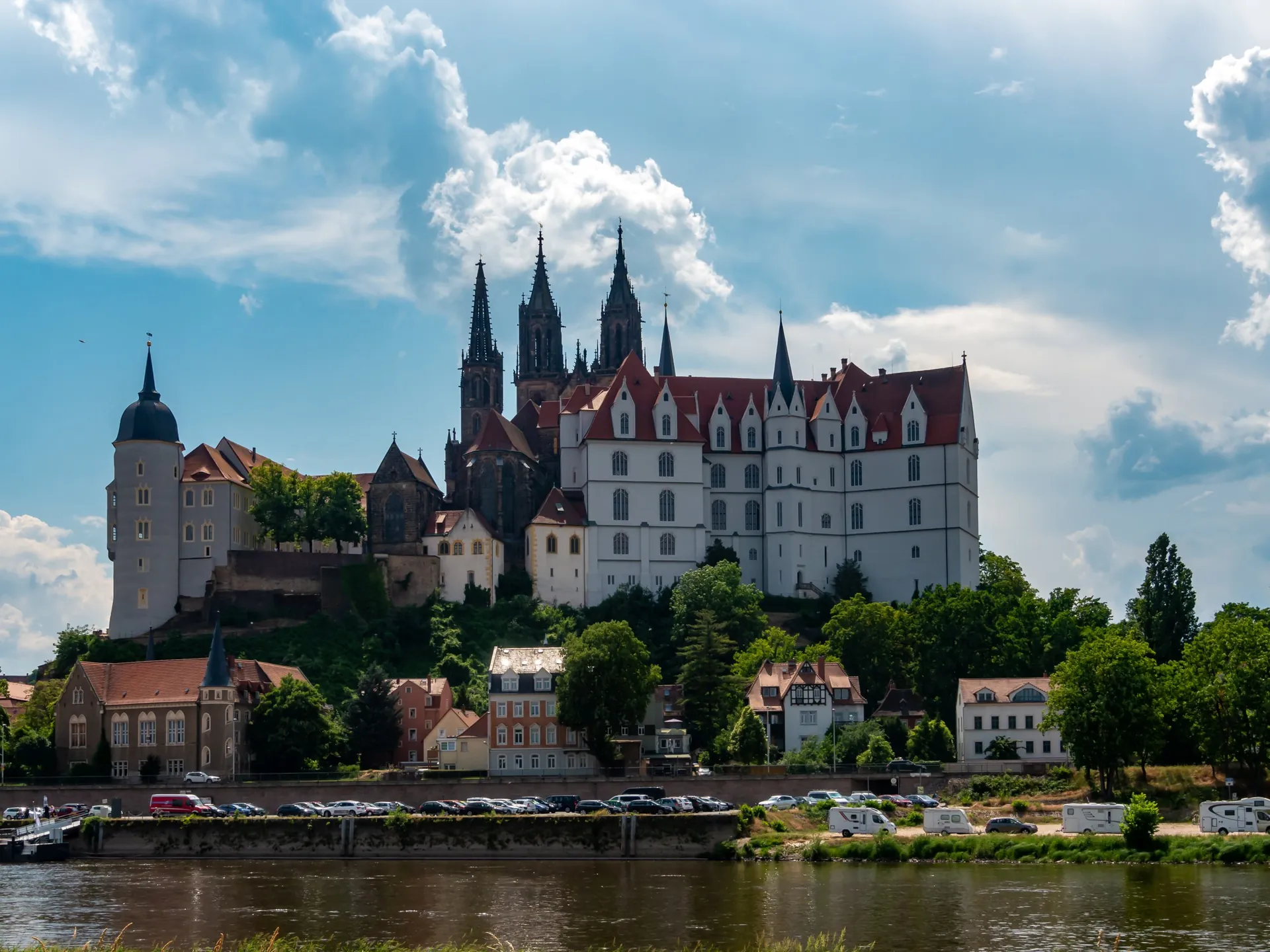
Meissen's castle and cathedral seen across the ElbeOn the Elbe, Saxony

Meissen's castle and cathedral seen across the ElbeMatti Blume / CC BY-SA 4.0

Meissen

Europe's first true porcelain manufactory was set up inside this castle.

Getting there●●○○○Easy on your own: about 35 minutes by S-Bahn from Dresden.

Best timeGood all year

Half a day from Dresden is Meissen, the porcelain town.

On a hill above the Elbe, a white castle and a Gothic cathedral stand shoulder to shoulder, their spires piercing the clouds. Construction of the Albrechtsburg began in the 15th century, and it is often called the first castle in Germany built as a palace. In 1710 Saxony's ruler set up Europe's first true (hard-paste) porcelain manufactory inside it, and Meissen porcelain became a byword for European porcelain — its crossed blue swords mark is still used today. The manufactory has since moved outside the old town, where you can watch craftspeople throw and hand-paint the pieces. The old town is small: cobbled lanes climb from the river to the castle, and an afternoon is enough to see it.

GETTING THEREFrom Dresden Hauptbahnhof, take the S-Bahn to Meissen (about 35 minutes), then walk about 15 minutes to the old town. In summer you can also take an Elbe paddle steamer from Dresden — check the official site for schedules.
GOOD TO KNOWAutumn, when the Elbe vineyards turn gold at harvest, is the loveliest time. Check porcelain workshop tour times and languages on the official site; the castle and cathedral are ticketed separately.
SAFETYThe steps and ramps up to the castle are steep and slippery in the rain — wear good shoes.
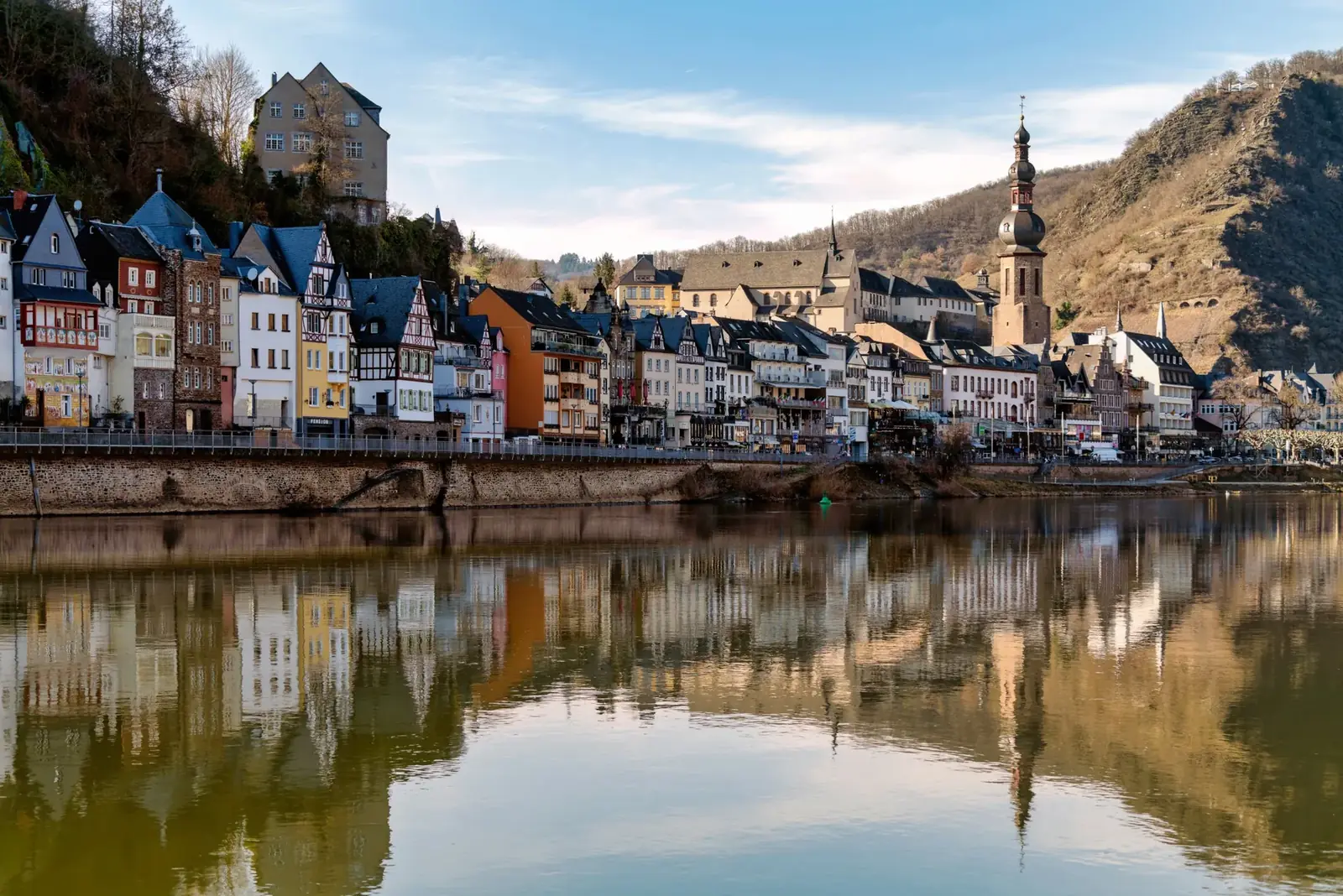
Cochem's old town on the MoselleMoselle valley, Rhineland-Palatinate

Cochem's old town on the MoselleRolf Kranz / CC BY-SA 4.0

Cochem

A colourful town in a bend of the Moselle, with vineyards all around.

Getting there●●○○○Easy on your own: about 45 minutes by train from Koblenz; the riverside old town is about 10 minutes' walk from the station.

Best timeMay–Oct

To spend a few days in a riverside town wrapped in vineyards, go to Cochem.

The Moselle makes a wide bend here. A row of colourful old houses is reflected in the water, a church tower with an onion dome rises in the middle, and the slopes behind are covered in vines. The Moselle valley is one of Germany's best-known white-wine regions, with grapes grown on very steep hillsides. Cochem also has a castle on the hilltop, visible from the river (it's not in this photo) — you can walk up to visit it, or take the seasonal chairlift to a viewpoint on the opposite hill for a look at the whole bend. In summer, drift along the river on a boat trip past villages and vineyards.

GETTING THEREAbout 45 minutes by regional train from Koblenz; about 1 hour from Trier. The riverside old town is about 10 minutes' walk from the station. The chairlift and boats run seasonally — check the official sites.
GOOD TO KNOWLate summer into autumn is the liveliest: the 2026 Cochem wine festival ran August 27–31, with a parade on the 30th and fireworks around 10 pm, and there's a new-wine festival on weekends in late October and early November. Vineyards are private — stay on the paths and don't pick grapes. Book early for festival dates, and check this year's schedule.
SAFETYThe riverside path doesn't have railings all the way — watch children. In winter the river occasionally floods the riverside path; keep away when it does.
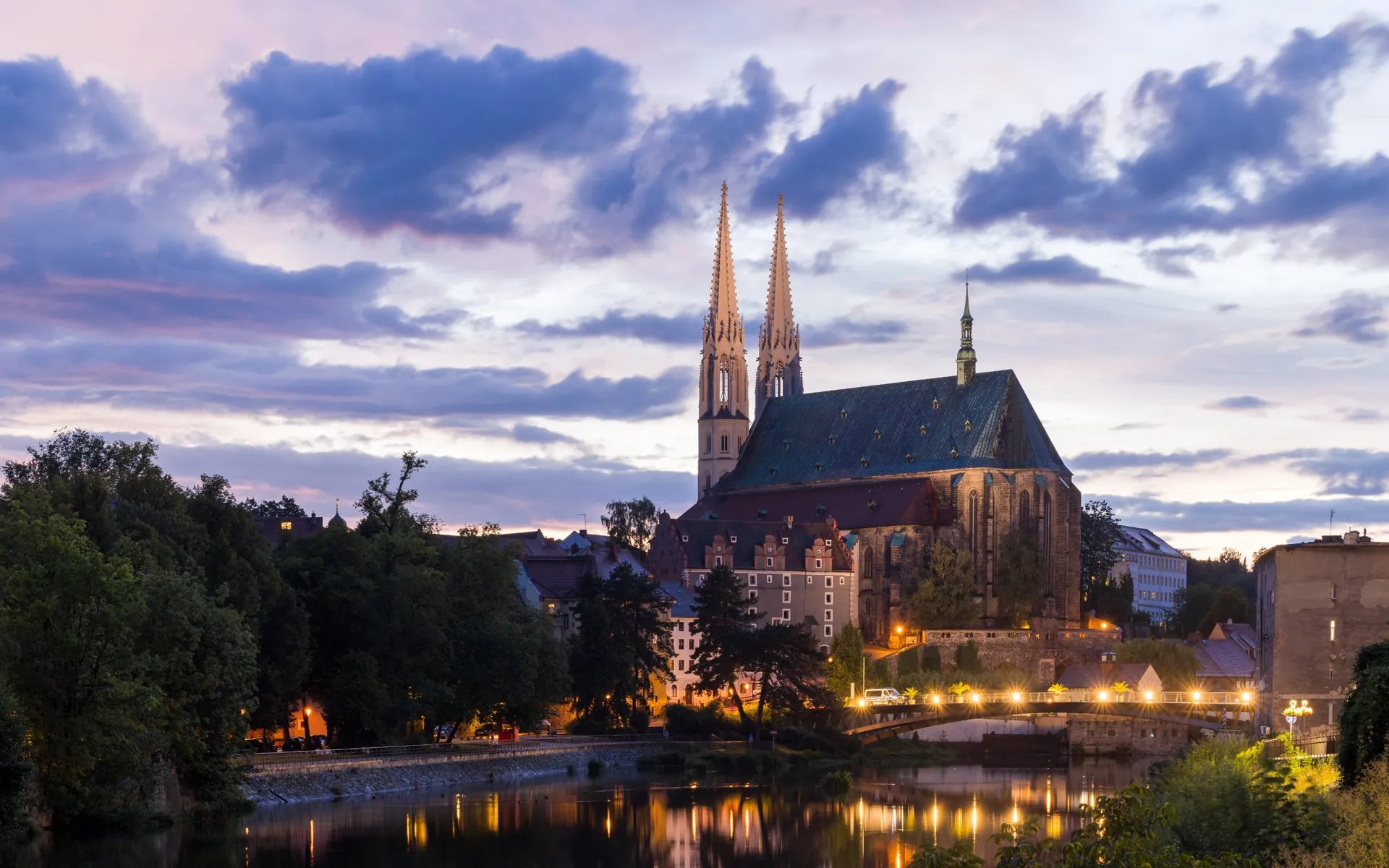
The Church of St. Peter and Paul on the NeisseSaxony, Germany's easternmost city

The Church of St. Peter and Paul on the NeisseImage: Martin Kraft (photo.martinkraft.com) / License: CC BY-SA 4.0 / via Wikimedia Commons

Görlitz

Cross one bridge and you've walked from Germany into Poland.

Getting there●●●○○Doable on your own: about 1.5 hours by train from Dresden; the old town is about 15 minutes' walk from the station.

Best timeGood all year

To walk through two countries in one day, go to Görlitz, Germany's easternmost city.

The Neisse flows quietly past a church with two spires, and on the other side of that lit-up footbridge is Poland. Görlitz is Germany's easternmost city: after the Second World War the east bank went to Poland, and one town became two countries. The old town came through the war almost unscathed, preserving houses from Gothic and Renaissance to Art Nouveau, and many films have been shot here — most famously The Grand Budapest Hotel — earning it the nickname “Görliwood”. Cross the old town bridge into Zgorzelec, Poland, and you can eat in two countries in one day.

GETTING THEREAbout 1.5 hours by train from Dresden; 2.5 to 3 hours from Berlin, usually with a change. The old town is about 15 minutes' walk from the station.
GOOD TO KNOWEarly morning and evening are when the old town is quietest, and crossing to the Polish side takes just minutes. Poland uses the złoty (PLN), not euros, so check whether shops take cards. Both are Schengen countries, so there's usually no passport check on the bridge, but carry your passport anyway.
SAFETYThe old town's cobbles are uneven and the lighting is dim at night — watch your step.
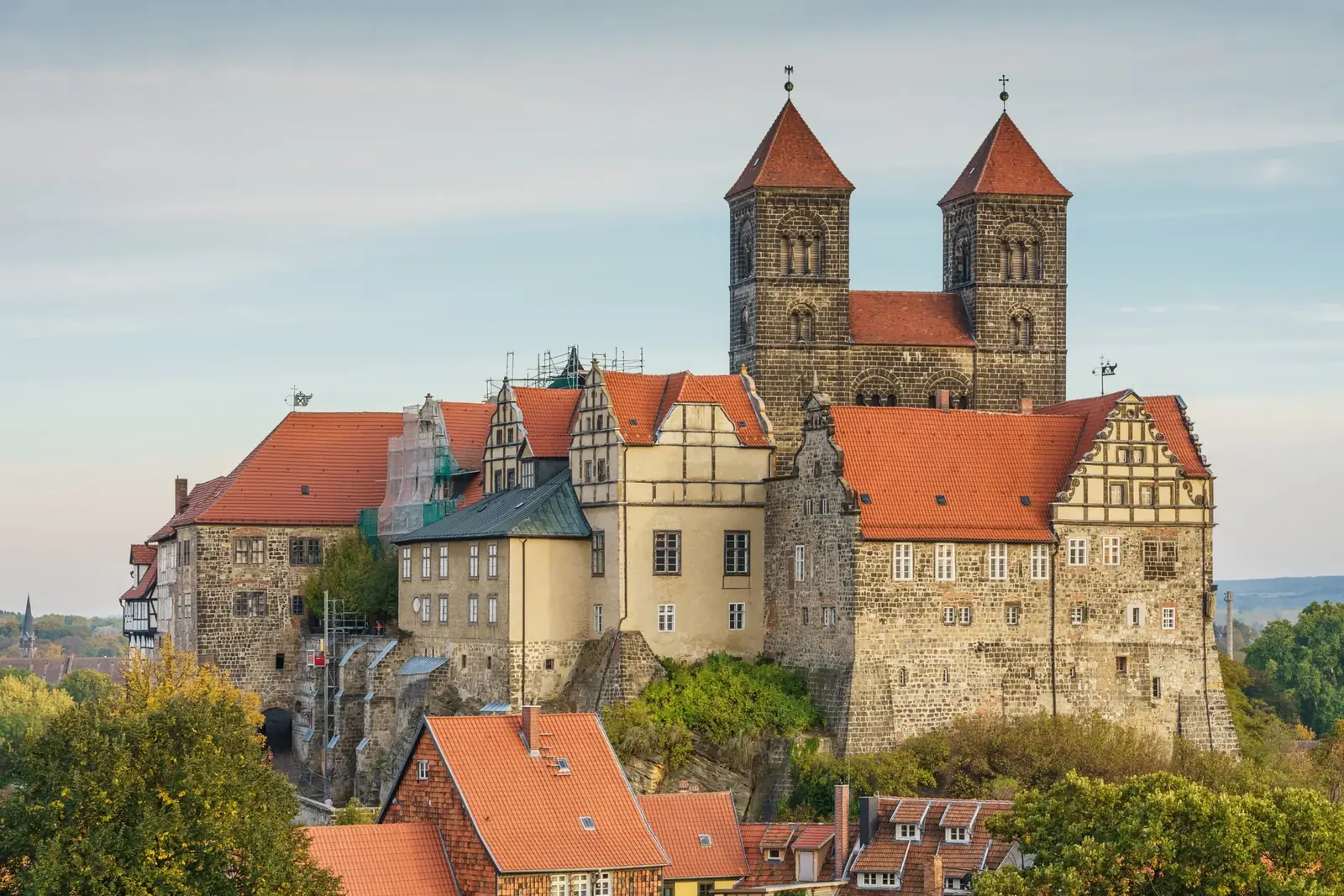
Quedlinburg's castle hill and St. Servatius Collegiate ChurchFoot of the Harz, Saxony-Anhalt

Quedlinburg's castle hill and St. Servatius Collegiate ChurchA.Savin, Wikipedia / Free Art License

Quedlinburg

More than a thousand half-timbered houses around a castle church on a hill.

Getting there●●●○○Doable on your own: just over 1 hour by regional train from Magdeburg; about 3 hours from Berlin with a change.

Best timeMay–Sep, Dec

For one of Germany's towns with the most half-timbered houses, go to Quedlinburg.

Red-roofed houses climb in tiers to a hilltop crowned by a castle and a Romanesque church with two square towers. Quedlinburg has more than a thousand half-timbered houses spanning several centuries — one of the largest collections in Germany — and became a World Heritage site in 1994. The Collegiate Church of St. Servatius on the hill is the burial place of Henry I, often called the first German king, and its treasury holds medieval gold and silver work and manuscripts. On weekends before Christmas, the courtyards of old houses open for small markets. You can also ride a steam narrow-gauge train into the Harz mountains from here — check the official site for times.

GETTING THEREJust over 1 hour by regional train from Magdeburg; about 3 hours from Berlin, usually changing at Magdeburg. The old town is about 10 minutes' walk from the station.
GOOD TO KNOWDecember's Advent in the courtyards is the most special time, when normally closed courtyards open up; any evening the half-timbered streets are lovely. Many houses are lived in, so don't walk into private courtyards. The church and treasury on Castle Hill are ticketed separately — check hours on the official site.
SAFETYThe ramps and steps on the castle hill are steep and slippery in the rain.

Winter ski areas & events

Coming in winter? The region also has these. Full details (lessons, lodging, transport) are in the winter corner of your quiz results.

Ski areas

  • Zugspitze: Germany's highest peak and its only glacier ski area
  • Oberstdorf: Germany's southernmost ski town and a ski-jumping legend
  • Sudelfeld: One of Bavaria's biggest ski areas, with wide, gentle runs
  • Reit im Winkl · Winklmoosalm: A famously snowy village, with slopes that run into Austria
  • Spitzingsee: Munich's favorite weekend ski area
  • Feldberg: The Black Forest's highest peak and Germany's biggest ski area outside the Alps
  • Mittenwald: A painted village under snowy peaks, made for slow stays
  • Wurmberg: Northern Germany's biggest ski area, with fairy-tale frosted forests
  • Todtnauberg: A small Black Forest village with quiet, unhurried slopes
  • Brauneck: A classic ski hill south of Munich, top to valley

Winter events

  • Munich Christmas Market: A giant tree in front of the New Town Hall, the heart of Munich's winter
  • Nuremberg Christkindlesmarkt: Red-and-white striped stalls at one of the world's most famous Christmas markets
  • Dresden Striezelmarkt: One of Germany's oldest Christmas markets, in its 592nd year
  • Gendarmenmarkt Christmas Market: A Christmas market framed by two cathedrals and a concert hall
  • Winter World at Potsdamer Platz: Slide down a snow-tube run in the middle of Berlin
  • Friedrichsbad, Baden-Baden: The warmest winter plan: a 19th-century Roman-Irish bath
  • Altenberg Bobsleigh Track: A world-class ice track where anyone can ride a bobsleigh
  • Nymphenburg Canal: When it's cold enough, skate on the ice in front of a palace

Not sure which to pick? Take the 4-minute travel-personality quiz and find the one that suits you.

Take the quiz