TOP-TIER TRAVEL中/EN

Korea · Jeju Island

8 hidden gems in Jeju Island

Volcanic island & haenyeo. We picked 8 places in this region — some well known, some few visitors find. Browse at your own pace, then take the quiz when something catches your eye.

TOP-TIER TRAVEL › All hidden gems › Korea › Jeju Island

Not sure which to pick? Take the 4-minute travel-personality quiz and find the one that suits you.

Take the quiz
Seongeup Folk Village
First time? Start with the classics

You can't go wrong doing a first lap of Seongsan Ilchulbong, Hallasan, the Jungmun resort area and Dongmun Market. Jeju is bigger than you'd think — driving from one end to the other takes over an hour, and buses are infrequent — so save just a day or two for the place below that's truly yours.

Looking for a place to stay in this area? Start here:

Spot details checked: October 2026

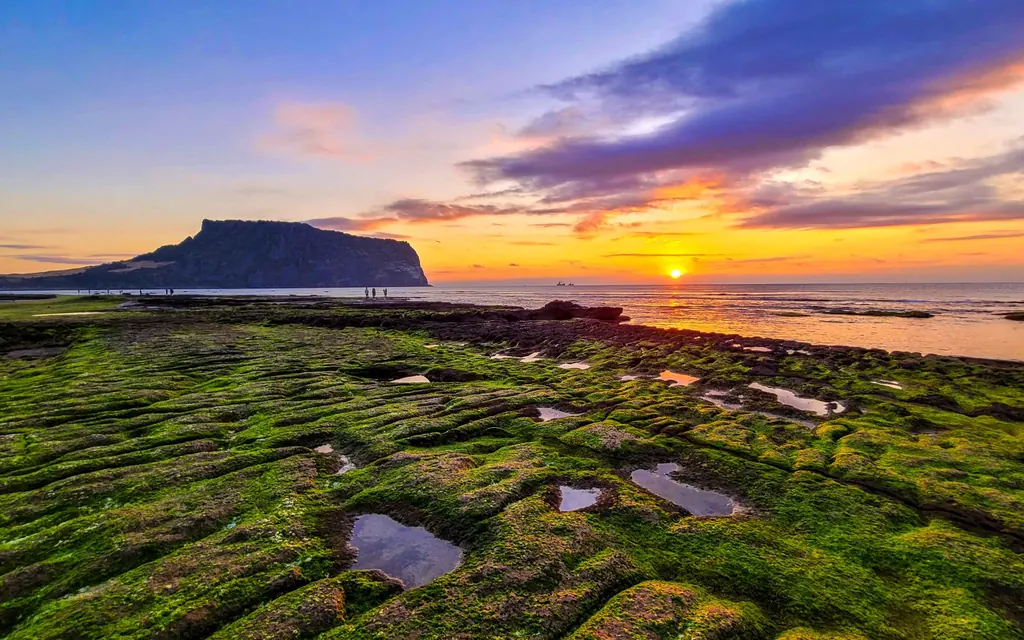
Sunrise over Seongsan Ilchulbong from Gwangchigi Beach, with mossy rocks in frontSeogwipo, Jeju

Sunrise over Seongsan Ilchulbong from Gwangchigi Beach, with mossy rocks in front

Seongsan Ilchulbong

The sun rises behind a crater born 5,000 years ago.

Getting there●●○○○Easy on your own: about 1.5 hours by bus from Jeju Airport or Jeju City.

Best timeGood all year

On Jeju, see Seongsan Ilchulbong at least once.

Before dawn the rocks of Gwangchigi Beach are carpeted with moss, the tide far out; the sky slowly brightens, the silhouette of Seongsan Ilchulbong sharpens in the early light, and the sun rises right beside it. Seongsan Ilchulbong is a tuff cone crater formed by an undersea volcanic eruption about 5,000 years ago. About 180 m high, it has a huge round crater at the top, and in 2007 it became a World Natural Heritage Site together with Jeju's lava tubes. The photo is exactly that sunrise from Gwangchigi Beach, where the mossy rocks appear at low tide in front of the peak. After sunrise, climb to the summit, about 30–40 minutes, and look out over the whole crater and Seongsan Port as the wind blows in from the sea. Haenyeo diving shows are also often held on the shore below. In Jeju, get up early for this at least once.
GETTING THEREAbout 1.5 hours by bus from Jeju Airport or Jeju City. Seongsan Port is also where ferries leave for Udo, so you can do both in one day.
GOOD TO KNOWWatching sunrise from the crater rim is unforgettable — check the sunrise time, and since early buses are scarce, stay near Seongsan. The mossy rocks at Gwangchigi Beach only show at low tide. There are closed days, so check entry times on the official site.
SAFETYThe summit steps are steep and slippery in the rain. The mossy shore rocks are extremely slippery — leave quickly as the tide comes in.
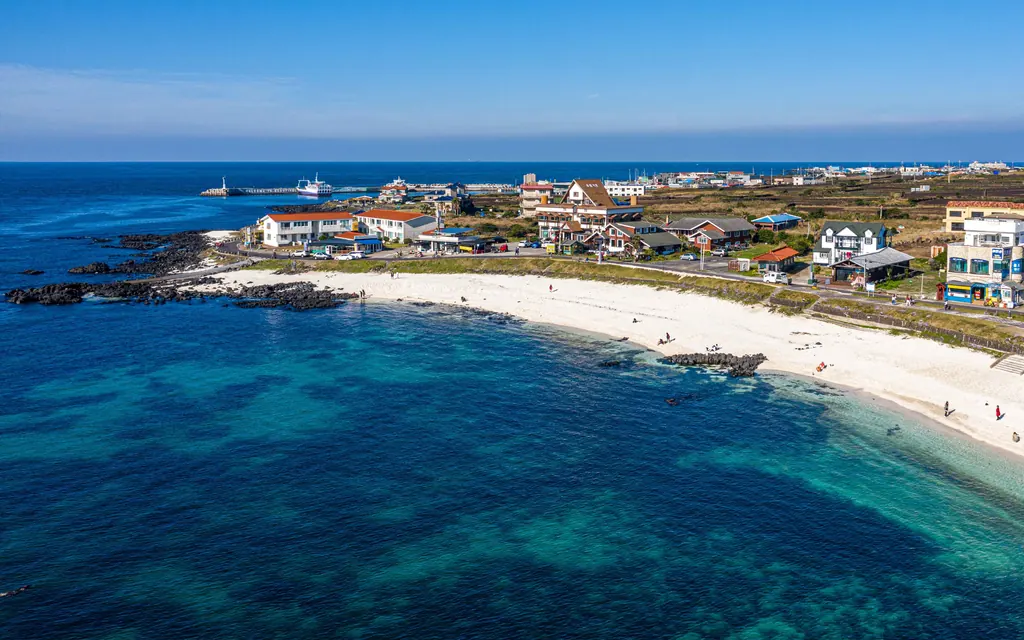
Udo's white beach and clear water from aboveJeju City, Jeju

Udo's white beach and clear water from above

Seobin White Sand, Udo

A little island shaped like a resting cow, with a beach that isn't coral.

Getting there●●○○○Easy on your own: about 1.5 hours by bus to Seongsan Port, then a 15-minute ferry.

Best timeMay–Oct

When you visit Seongsan Ilchulbong, hop on the ferry to Udo.

The ferry docks and you set off along the coast, sea wind in your face, until round a bend a white beach appears, the water shifting in the sun from pale green to deep blue, so clear you can see the bottom. Udo lies off Jeju's east coast and is shaped like a cow lying down. Its most famous beach, Seobin White Sand, is made not of coral but of small calcified red algae nodules (rhodoliths); it used to be called the “coral beach,” and it's a designated natural monument. You can rent an electric vehicle or bicycle to circle the island, and when you're tired, a peanut ice cream is the taste of Udo. Spend a day riding slowly around this little island, and you won't want to catch the last boat back.

GETTING THEREAbout 15 minutes by ferry from Seongsan Port; Seongsan Port is about 1.5 hours by bus from Jeju City.
GOOD TO KNOWRapeseed blooms in April and the bluest water in summer make it perfect for circling the island by e-scooter. Ferries may stop in rough seas. Most rental cars can't go onto Udo, with exceptions for lodging guests or people with limited mobility; rules change often, so ask your rental company. Don't take sand from the beach. Confirm ferries before you go.
SAFETYThe island's roads are narrow and busy with rental e-vehicles — slow down. The summer sun is strong, so wear sunscreen.
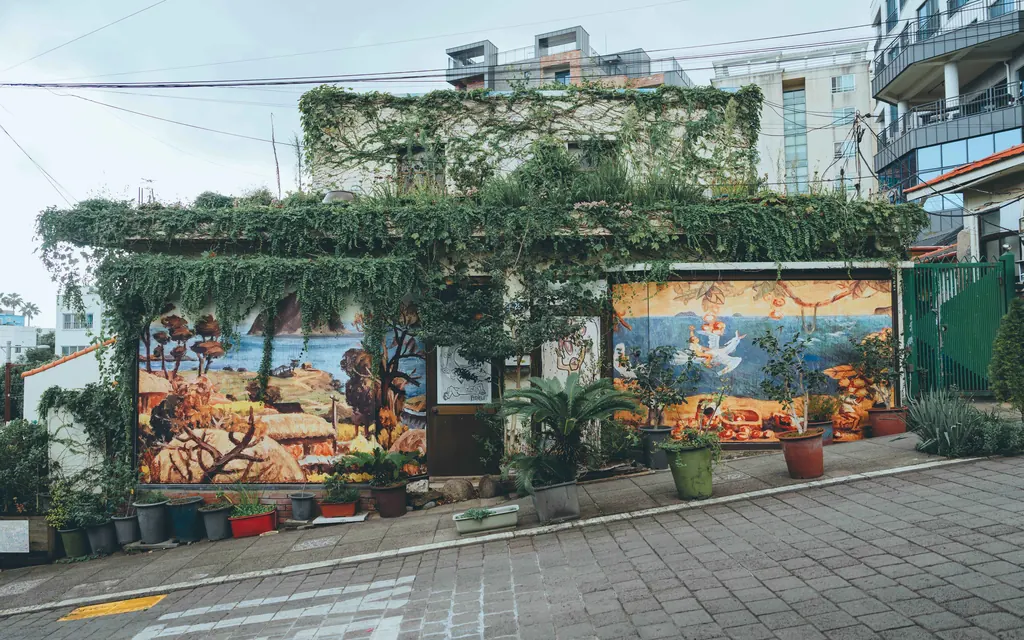
Ivy-covered murals along Lee Jung-seop StreetSeogwipo, Jeju

Ivy-covered murals along Lee Jung-seop Street

Lee Jung-seop Street, Seogwipo

In a tiny thatched room, a painter drew Seogwipo's sea and crabs.

Getting there●●○○○Easy on your own: just over an hour by airport bus from Jeju Airport to Seogwipo, then a walk.

Best timeGood all year

In Seogwipo, stroll down the painter's little street.

Push open the door of the thatched house and the room inside is so small it barely fits a few people; it's hard to imagine a whole family lived here for almost a year. Step back out and Seogwipo's sea lies in the distance, a breeze crossing the eaves. Lee Jung-seop is one of Korea's most celebrated modern painters. During the Korean War he took refuge in Seogwipo with his family, living in this tiny thatched room and leaving many works of Seogwipo's sea, crabs and children. The Lee Jung-seop Art Museum stands next door, and the surrounding area is called Lee Jung-seop Street, with murals inspired by his paintings and a craft market on weekends. Walk downhill and you reach Seogwipo Maeil Olle Market and the Cheonjiyeon Falls area. Stand before that little house, and you'll understand where the warmth in his paintings came from.

GETTING THEREJust over 1 hour from Jeju Airport to central Seogwipo by airport bus, then walk to the street.
GOOD TO KNOWStrolling down the street to the sea in the late afternoon is the nicest way to see it, and there are often small weekend markets. The Lee Jung-seop Art Museum has closed days, so check the official site. It's a residential area — keep your voice down.
SAFETYThe street slopes, and the stone paving is slippery in the rain.
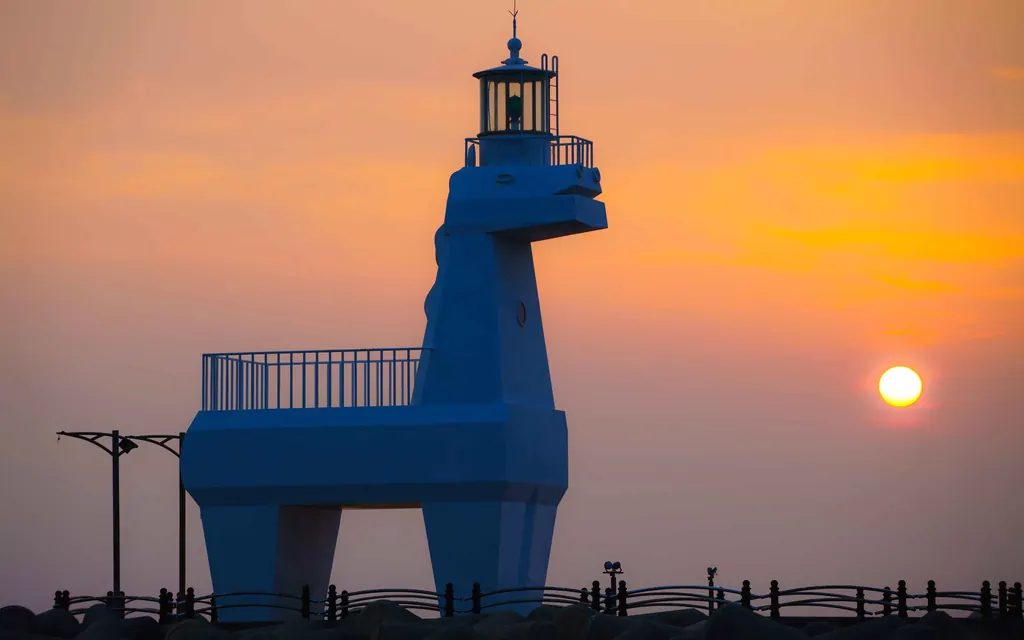
The Iho Tewoo horse lighthouse at sunsetJeju City, Jeju

The Iho Tewoo horse lighthouse at sunset

Horse Lighthouses, Iho Tewoo

One red horse, one white, keeping you company at a Jeju sunset.

Getting there●○○○○Very easy on your own: 15–20 minutes by bus or taxi from Jeju Airport.

Best timeGood all year

On your first or last day on Jeju, watch the sunset at the beach next to the airport.

Sit on the breakwater as small waves lap against it and the sun sinks slowly into the sea, the sky turning from gold to orange-red, and the red and white horse-shaped lighthouses at either end become silhouettes. Iho Tewoo Beach is only a 10-something-minute drive from Jeju Airport, one of the closest beaches to the city. Its two lighthouses, shaped like Jeju horses, have become its signature view; Jeju horses are a small native breed designated a natural monument. Many people come on the day they arrive in or leave Jeju, catching a sunset fresh off the plane or saying goodbye to Jeju with one. The first day or the last day of your trip, either deserves an evening by this sea.

GETTING THEREAbout 15–20 minutes by bus or taxi from Jeju Airport.
GOOD TO KNOWAt sunset the two horse lighthouses turn into silhouettes — the best time for photos; check the season's sunset time. The breakwater is exposed and windy, so bring a jacket.
SAFETYDon't climb onto the breakwater's concrete blocks for photos, and stay back from the edge when the waves pick up.
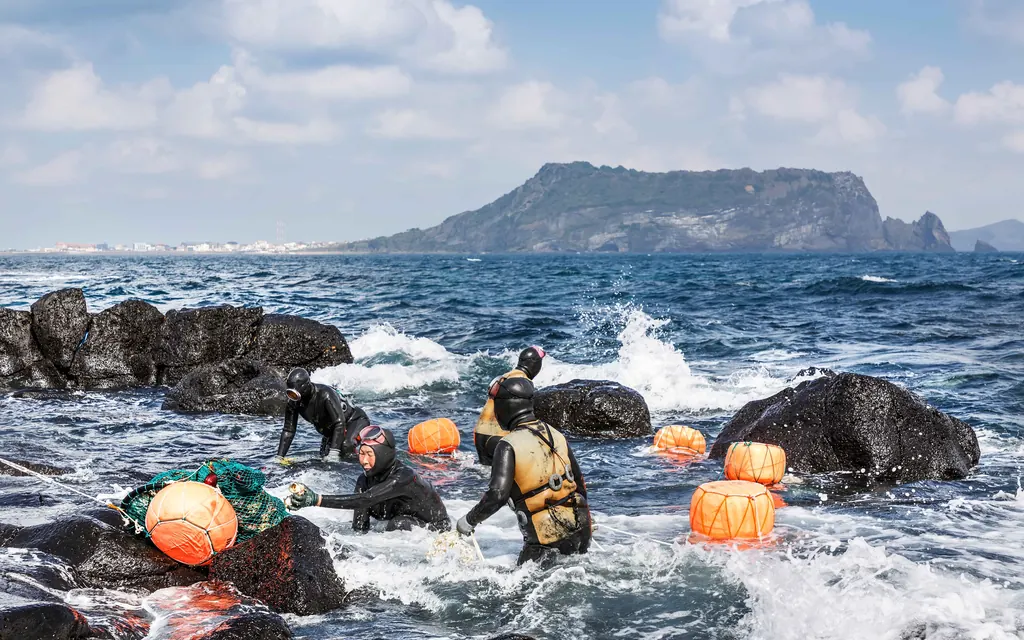
Haenyeo divers at work near Seongsan, with their orange floatsSeongsan, Seogwipo, Jeju

Haenyeo divers at work near Seongsan, with their orange floats

Jeju Haenyeo

One breath down into the sea, and a whistle on the way up.

Getting there●●○○○Easy on your own: 1–1.5 hours by bus from Jeju City.

Best timeGood all year

To meet Jeju's most iconic people, watch a haenyeo performance.

Orange floats bob on the water; suddenly a haenyeo surfaces and lets out a long breath like a whistle, rests a moment, then dives back down, spray scattering around her. Haenyeo are Jeju's women divers who collect conch, abalone and seaweed on a single breath, without breathing equipment; the tradition was inscribed on UNESCO's Representative List of the Intangible Cultural Heritage of Humanity in 2016. That whistle-like breath is called sumbisori, and the orange float, the taewak, is used for resting and holding the catch. The photo shows haenyeo working near Seongsan. There are haenyeo performances on the shore below Seongsan Ilchulbong, and the Haenyeo Museum in northeast Jeju explains their lives in depth. Hear that whistling breath once, and you'll remember how these women have kept this sea.

GETTING THEREAbout 1.5 hours by bus from Jeju City to Seongsan. The Haenyeo Museum is in Gujwa-eup, Jeju City, about 1 hour by bus.
GOOD TO KNOWThe moment a haenyeo surfaces with her long, whistling breath is the one to remember. Show times and whether it runs depend on on-site notices, and bad weather cancels it; the Haenyeo Museum has closed days. If you see divers working, keep your distance and don't disturb them. Check the latest updates first.
SAFETYShoreline rocks are slippery; stay away from areas with big waves.
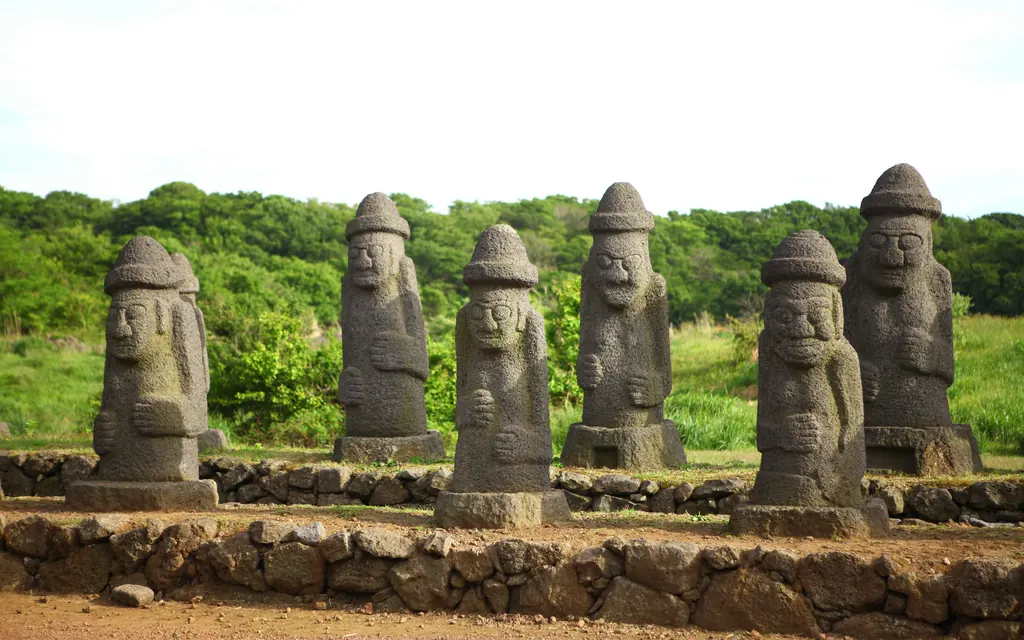
A row of dol hareubang stone figures in Jeju Stone ParkJeju City, Jeju

A row of dol hareubang stone figures in Jeju Stone Park

Jeju Stone Park

A whole field of stone grandfathers, quietly guarding the island.

Getting there●●●○○Some planning: 30–40 minutes from Jeju City, but buses are infrequent; a rental car or private driver is easier.

Best timeGood all year

To understand Jeju's stone culture, visit Jeju Stone Park.

Walk into the park and black stone grandfathers stand one after another on the grass, round eyes and big noses, some seeming to smile, some looking stern, so quiet all you hear is the wind in the grass. Jeju is a volcanic island where black basalt is everywhere, and people used it to build walls, houses and guardian figures. Jeju Stone Park is themed on the myth of Seolmundae Halmang, the giant goddess who created Jeju. It has a stone culture museum, a traditional thatched-house village, and a large outdoor display of dol hareubang (“stone grandfathers”) and other stone figures; the photo shows the stone grandfathers. It's much quieter than the busier sights and great for a slow walk. Trade glances with these stone grandfathers for a while, and you'll feel Jeju's stories are carved into the stone.

GETTING THEREAbout 30–40 minutes by bus or taxi from Jeju City. Public transport is infrequent, so renting a car or hiring a driver is easier.
GOOD TO KNOWAutumn silver grass and stone statues after snow are the most atmospheric. The park is large — allow 2+ hours for the full loop. It has closed days, so check the official site.
SAFETYPaths are gravel and dirt, so wear good shoes; the summer sun is strong.
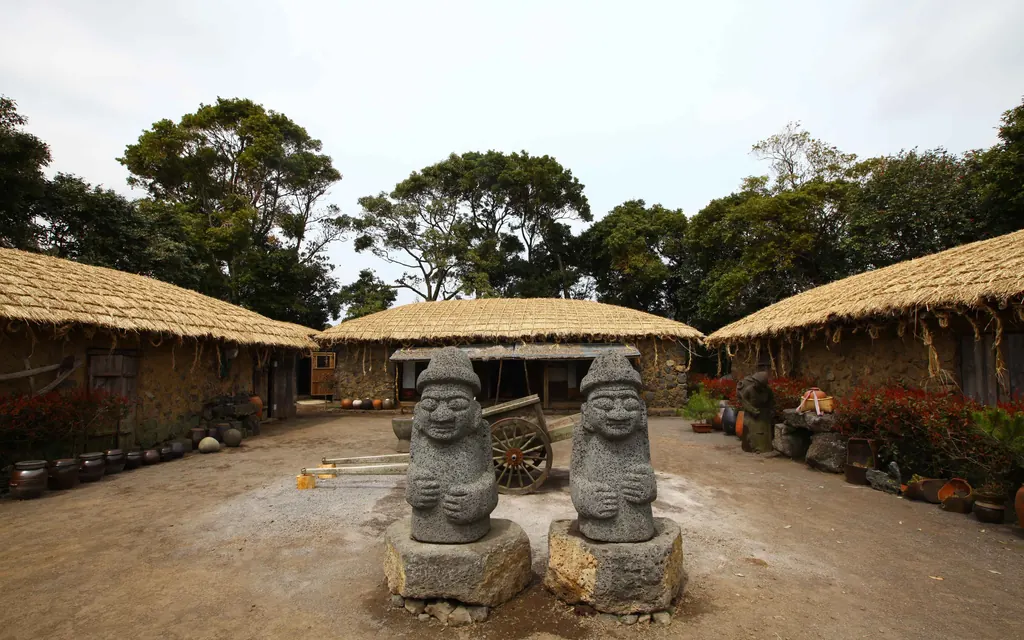
Stone figures in front of thatched houses in Seongeup Folk VillagePyoseon, Seogwipo, Jeju

Stone figures in front of thatched houses in Seongeup Folk Village

Seongeup Folk Village

Roofs tied down with rope nets, a village living with Jeju's wind.

Getting there●●○○○Easy on your own: about an hour by bus from Jeju City.

Best timeGood all year

To see a traditional Jeju thatched village, visit Seongeup Folk Village.

Walk into the village and walls of stacked volcanic stone wind around thatched houses, their roofs tied down with nets of rope, the wind slipping through gaps in the stone with a soft whistle. In the Joseon era, Seongeup was the county seat of Jeongui. The village keeps Jeju's distinctive thatched houses: to withstand strong winds, the thatch is tied down with a net of ropes, and the walls are stacked volcanic stone. People still live here, and it's a designated National Folklore Cultural Heritage; the stone grandfathers were first discovered in this area. After your walk, try Jeju black pork, sizzling on the grill. Here you'll see how Jeju's people have lived with the wind and the stone for centuries.

GETTING THEREAbout 1 hour by bus from Jeju City; it pairs well with Seongsan Ilchulbong on the same day.
GOOD TO KNOWMornings, before the crowds, have the most old-village calm. People live here, so don't enter houses that aren't open. Guides sometimes sell local products — a polite no is fine.
SAFETYCars drive through the village, so watch for traffic while taking photos.
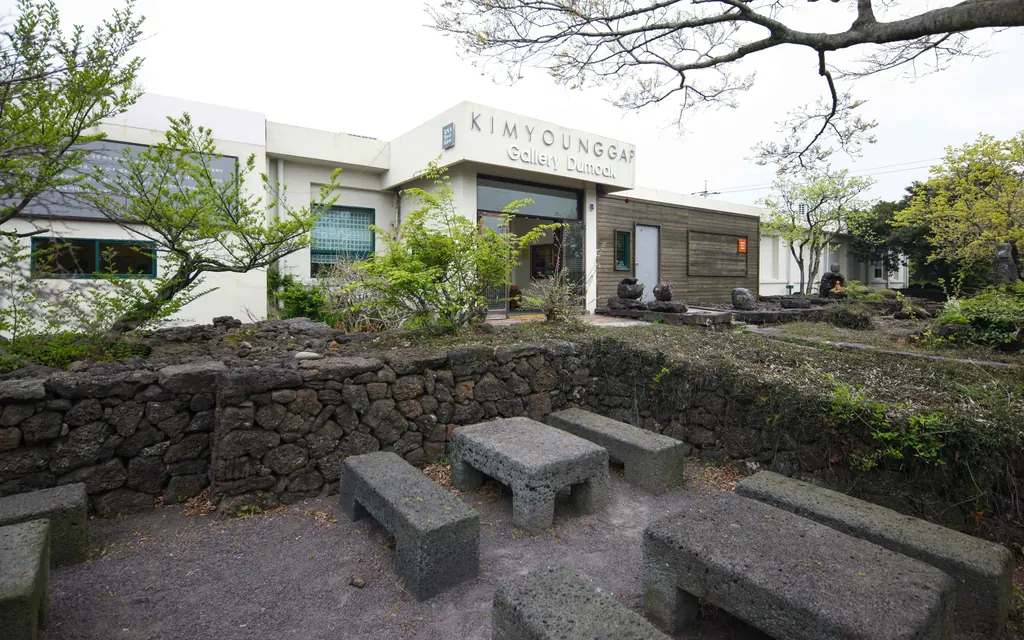
The Kim Young-gap Gallery Dumoak and its stone gardenSeongsan, Seogwipo, Jeju

The Kim Young-gap Gallery Dumoak and its stone garden

Kim Young-gap Gallery Dumoak

One man, one island, twenty years of wind.

Getting there●●○○○Easy on your own: about 1.5 hours by bus from Jeju City, then a 5-minute walk.

Best timeGood all year

To find a quiet place Jeju locals love too, visit this little gallery.

Push open the door of an old branch school and the walls are full of Jeju's grasslands, volcanoes and wind, so still you can almost hear the wind; out in the yard, the volcanic stone walls and benches were set in place by his own hands, stone by stone. Photographer Kim Young-gap moved to Jeju alone in the 1980s and spent twenty years photographing its oreum (small volcanic cones), grasslands and wind. He turned this abandoned elementary branch school into the Dumoak gallery; Dumoak is an old name for Hallasan. After being diagnosed with ALS, he kept tending the garden and exhibition rooms himself; he died in 2005, and the gallery is still run in his memory. Sit on a bench he placed and watch the wind cross the yard, and you'll be deeply moved by one man's love for an island.

GETTING THEREAbout 1.5 hours by bus from Jeju City to the Samdal-ri area of Seongsan, then about a 5-minute walk; it pairs well with Seongsan Ilchulbong and Seongeup Folk Village.
GOOD TO KNOWKim Young-gap's Jeju landscapes resonate most on a cloudy or misty day, and the garden outside is worth a walk. The gallery has closed days, so check the official hours. Stay quiet inside and check the photo rules.
SAFETYThe stone paths in the yard are uneven — watch your step.

Not sure which to pick? Take the 4-minute travel-personality quiz and find the one that suits you.

Take the quiz