TOP-TIER TRAVEL中/EN

Japan · Kyushu

10 hidden gems in Kyushu

Volcanoes & hot springs. We picked 10 places in this region — some well known, some few visitors find. Browse at your own pace, then take the quiz when something catches your eye.

TOP-TIER TRAVEL › All hidden gems › Japan › Kyushu

Not sure which to pick? Take the 4-minute travel-personality quiz and find the one that suits you.

Take the quiz
Umi Jigoku, Beppu
First time? Start with the classics

You can't go wrong doing a first lap of Fukuoka, Dazaifu, Yufuin and Nagasaki. Kyushu's shinkansen and limited expresses are convenient, but many sights still need a bus at the end, so save just a day or two for the place below that's truly yours.

Looking for a place to stay in this area? Start here:

Spot details checked: October 2026

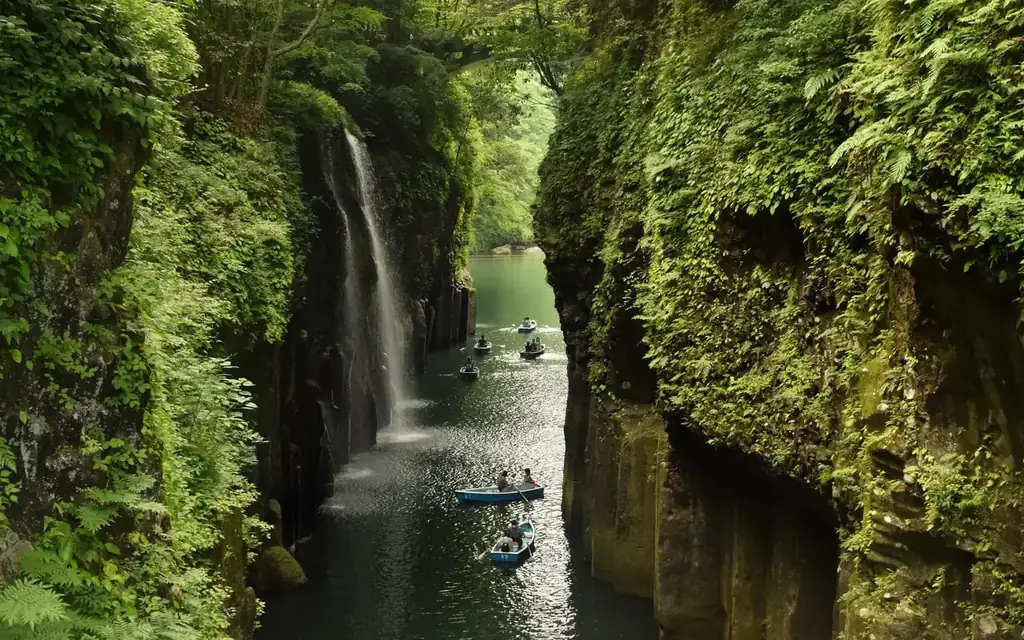
Manai Falls in the Takachiho Gorge, with rowing boatsTakachiho, Miyazaki

Manai Falls in the Takachiho Gorge, with rowing boats

Takachiho Gorge

Row into a myth, with a waterfall falling beside your boat.

Getting there●●●○○Fine on your own but slow: about 3 hours by bus from Kumamoto or Fukuoka, with few departures; plan to stay a night.

Best timeApr–May, Oct–Nov

To row into a gorge yourself and see a waterfall, add a stop at Takachiho.

One push of the oar and your boat slides into the gorge, sheer walls of columnar basalt on both sides and the sound of water echoing between them. Takachiho Gorge formed when lava from the Aso volcano cooled and was then cut through by the Gokase River. Its most famous sight, Manai Falls, drops straight off the cliff; rent a rowboat and you can paddle right up beside it, a fine mist settling on your face. Takachiho is also the home of Japanese mythology. After dark, go to Takachiho Shrine for its nightly hour of Takachiho Kagura, where drums and flutes strike up and classic scenes from the myths play out in front of you; in winter, villages hold all-night yokagura. Row into the gorge by day, watch the gods dance by night, and the whole day feels like stepping into an ancient storybook.
GETTING THEREThere's no railway to Takachiho. Buses run from Kumamoto or Fukuoka, about 3 hours, or about 1.5 hours by bus from Nobeoka Station in Miyazaki. Buses are infrequent, so staying a night in Takachiho is recommended.
GOOD TO KNOWSummer is greenest and autumn the most colourful — rowing through the gorge is the moment you'll remember. Boats are booked online, opening about two weeks ahead, and popular days fill fast; rentals stop after heavy rain, earthquakes or inspections. Kagura is performed most nights, except around New Year and during the late-November night kagura festival. Check the Takachiho tourism association site before you go.
SAFETYAlways wear a life jacket when rowing, and don't row directly under the waterfall. The gorge trails have steps and slippery sections — wear good shoes.
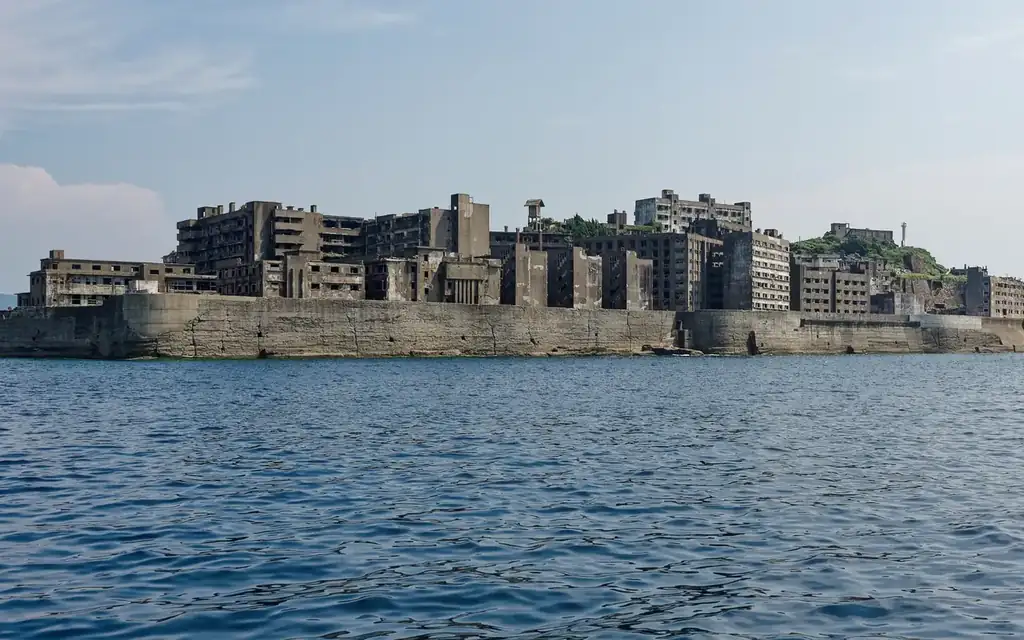
Gunkanjima's abandoned buildings from the seaNagasaki, Nagasaki

Gunkanjima's abandoned buildings from the sea

Gunkanjima (Battleship Island)

Five thousand people left, and the island was left at sea.

Getting there●●○○○Easy with a tour: you can only visit on a landing tour from Nagasaki Port, 2.5–4 hours in total.

Best timeApr–Jun, Sep–Nov

In Nagasaki, save half a day for a boat trip to the abandoned city at sea.

The boat rises and falls on the open-sea swell until a gray island slowly appears in the distance, its outline really does look like a battleship anchored at sea. Gunkanjima, officially Hashima, is an undersea coal-mining island off Nagasaki. At its peak more than 5,000 people lived on the tiny island, and it had Japan's first reinforced-concrete apartment buildings. When the mine closed in 1974 everyone left, and the island was simply left at sea. Step ashore and all you hear is waves on the seawall and wind through empty window frames; it's hard to imagine this place once crowded with life. In 2015 it became a World Heritage Site as part of the “Sites of Japan's Meiji Industrial Revolution,” and today you can only visit on a landing tour, viewing from designated walkways. Look back from the walkway, and that silence stays with you for a long, long time.

GETTING THEREFrom Nagasaki Station, take the tram to the Nagasaki Port area; all the landing tours depart from piers there. Tours take about 2.5–4 hours depending on the operator.
GOOD TO KNOWSpring and autumn have the calmest seas and the best chance of landing. Several operators run tours, all needing reservations, and peak days sell out. In rough seas the tour may only circle the island or be cancelled — especially in winter and typhoon season. Some have age limits for small children, so read the terms and check conditions again before you go.
SAFETYYou may only walk on the open visitor routes; buildings can collapse at any time and entry is strictly forbidden. Seas can be rough — prepare if you get seasick.
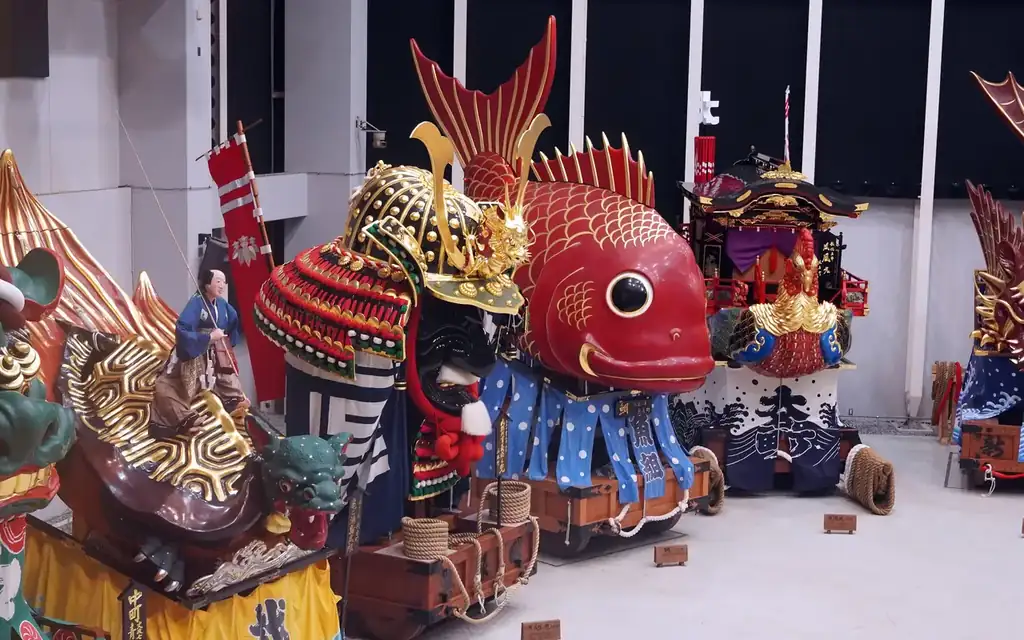
Karatsu Kunchi floats on display, including the red sea bream and a samurai helmetKaratsu, Saga

Karatsu Kunchi floats on display, including the red sea bream and a samurai helmet

Karatsu Kunchi Floats

Fourteen giant floats, running through a castle town.

Getting there●●○○○Easy on your own: about 1.5 hours from central Fukuoka on the subway running through onto JR, then a few minutes' walk.

Best timeNov

To see the stars of a Japanese festival up close, come to Karatsu to see the floats.

Shouts carry down from the end of the lane as townspeople in happi coats haul a giant red lion through the streets of the castle town. Karatsu Kunchi is the autumn festival of Karatsu Shrine, held every year from November 2 to 4, when 14 huge hikiyama floats, built up from layer upon layer of washi paper and lacquer, take their turns; it is inscribed on UNESCO's Intangible Cultural Heritage list. Every float has a different design. The oldest, the Red Lion, was made in 1819, and there's also a great red sea bream, a warrior's helmet, the Phoenix Ship and a dragon, their lacquer gleaming in the sun. You can see them outside the festival too: the 14 floats are normally kept in the Hikiyama Exhibition Hall, and the photo shows them on temporary display at the Furusato Kaikan Arpino while the hall is being rebuilt. See this two-hundred-year-old craftsmanship up close, and you'll start picturing the moment they run through the streets.

GETTING THEREFrom central Fukuoka, take the subway Airport Line, which runs through onto the JR Chikuhi Line to Karatsu Station — about 1.5 hours. The exhibit is temporarily inside Arpino, a few minutes' walk from the station.
GOOD TO KNOWThe highlight is Karatsu Kunchi, November 2–4, when all 14 floats parade through town. Those three days are packed — book a room very early — and the exhibition hall closes. The hall is also relocating and may be closed for a while from spring 2027, so check the Karatsu tourism association site before you go.
SAFETYThe floats move fast when they charge during the festival — follow staff instructions and watch from a safe distance.
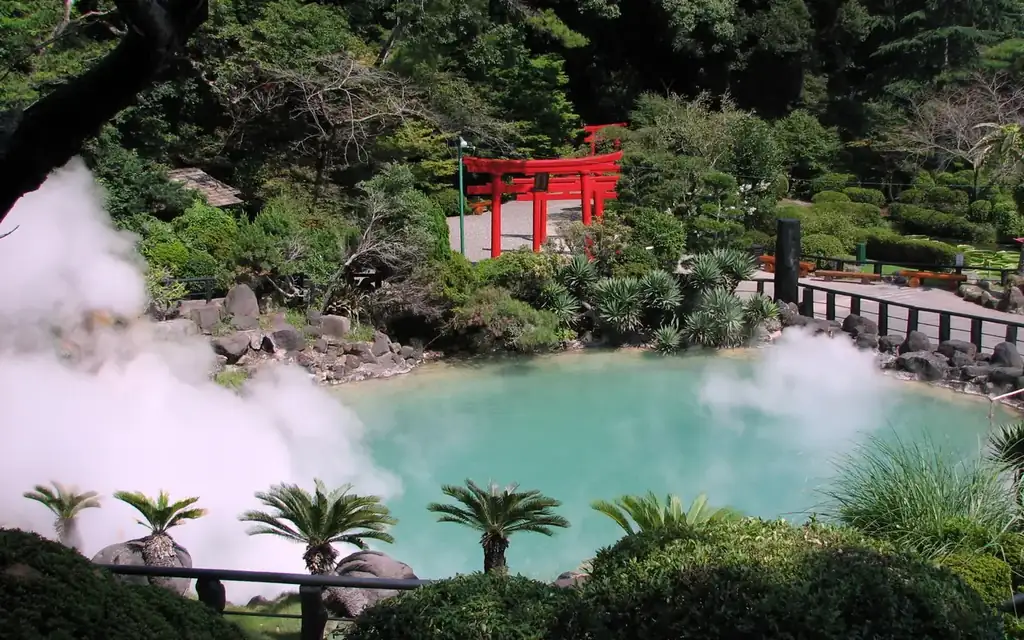
The steaming blue pool of Umi Jigoku, with a red torii behindBeppu, Oita

The steaming blue pool of Umi Jigoku, with a red torii behind

Beppu Hell Tour

A whole city steaming, and hell comes in seven colors.

Getting there●●○○○Easy on your own: about 2 hours by JR limited express from Fukuoka to Beppu, then about 20 minutes by bus.

Best timeGood all year

To see hot springs in every color, come to Beppu and tour the hells.

Walk Beppu's streets and look up: chimneys of white steam everywhere, a faint smell of sulfur in the air. Beppu has more hot springs and more flowing water than anywhere else in Japan, and the “Hells” tour takes you around seven naturally erupting hot-spring pools. Umi Jigoku is cobalt blue like the sea, Chinoike Jigoku is a churning red mud bath, and Tatsumaki Jigoku blasts out a geyser at regular intervals; several are designated National Places of Scenic Beauty. The pools are far too hot to bathe in, so afterwards soak at one of the city's public baths, or try jigoku-mushi, food steamed over hot-spring vapor, with a rush of heat in your face the moment the lid comes off. See hell in seven colors, then sink into a hot bath, and you'll understand why Beppu's people never want to leave their steaming city.

GETTING THEREAbout 2 hours from Fukuoka on the JR Sonic limited express to Beppu Station. Five of the seven hells are clustered in the Kannawa area, about 20 minutes by bus from Beppu Station; the other two (Chinoike and Tatsumaki) are a bus ride farther, in Shibaseki.
GOOD TO KNOWWinter is the most striking, when the cold air makes the steam billow even higher. A combined ticket covers all seven hells and you can see them in a day; five of them in Kannawa are walkable from each other. Check opening hours on the official site.
SAFETYThe water is very hot — don't cross the fences or touch it. Rinse before entering public baths, and don't stay long in the hotter ones.
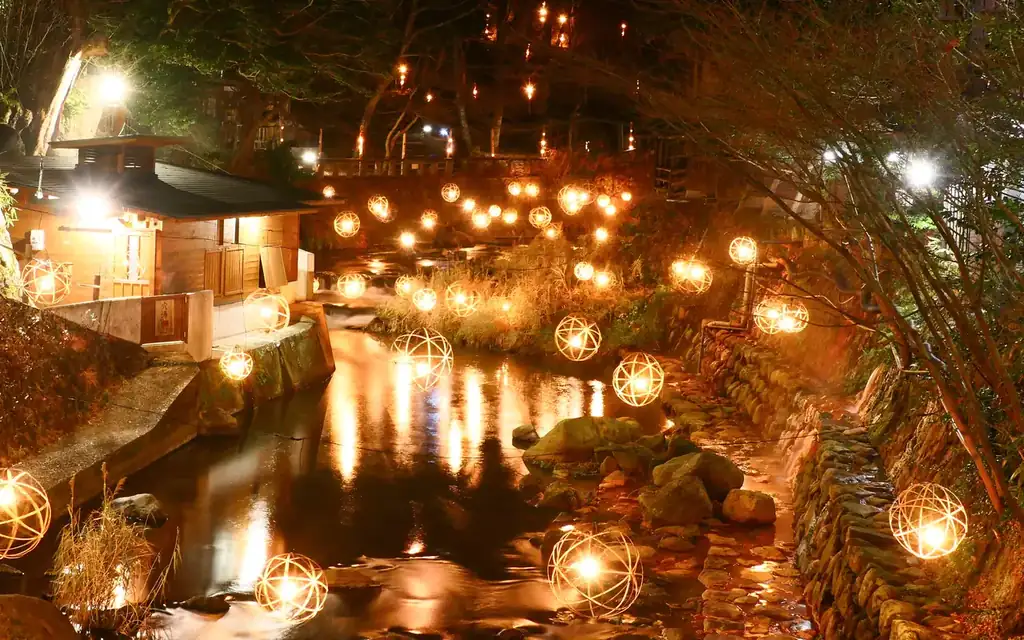
Bamboo lantern balls glowing along the stream, with the Anayu bathhouse on the leftMinamioguni, Kumamoto

Bamboo lantern balls glowing along the stream, with the Anayu bathhouse on the left

Kurokawa Onsen

One wooden pass, three baths, a whole valley to wander.

Getting there●●●○○Some planning: no railway; 2.5–3 hours by direct bus from Fukuoka or Kumamoto, mostly reservation only.

Best timeDec, Jan–Mar

To stay a night in the most atmospheric mountain hot-spring village, choose Kurokawa.

The stream murmurs past your feet as wooden inns and earthen walls line the Tanoharu River, with not a single big signboard in sight. Kurokawa Onsen sits in a valley north of Mount Aso, where about 25 inns deliberately keep a uniform look of wood, earthen walls and mixed woodland, like a village where time slowed down. It's famous for the nyuto tegata: buy a wooden pass and choose any three of the 25 inns' open-air baths (one can be used for food or souvenirs instead), then wander from bath to bath in a yukata and wooden geta. In winter's Yuakari season, about 300 bamboo mari-doro lanterns light up the stream and streets, their warm glow reflected in the water; the small hut on the left of the photo is the public bath Anayu. After your last bath, that wooden pass in your hand is the best keepsake of the trip.

GETTING THERENo direct railway. Direct buses from Fukuoka or Kumamoto take about 2.5–3 hours and mostly need booking. You can also take JR from Kumamoto to Aso Station and change to a bus.
GOOD TO KNOWWinter's Yu-akari is the most romantic time, with bamboo lanterns lit until 10 pm — in 2025–26 it ran December 20 to March 31, and dates vary a little each year. Weekend rooms go fast, so book early, and check this year's dates on the Kurokawa Onsen official site.
SAFETYThe town is all slopes and stone steps with dim light at night — watch your step. Mountain winters can bring snow and ice.
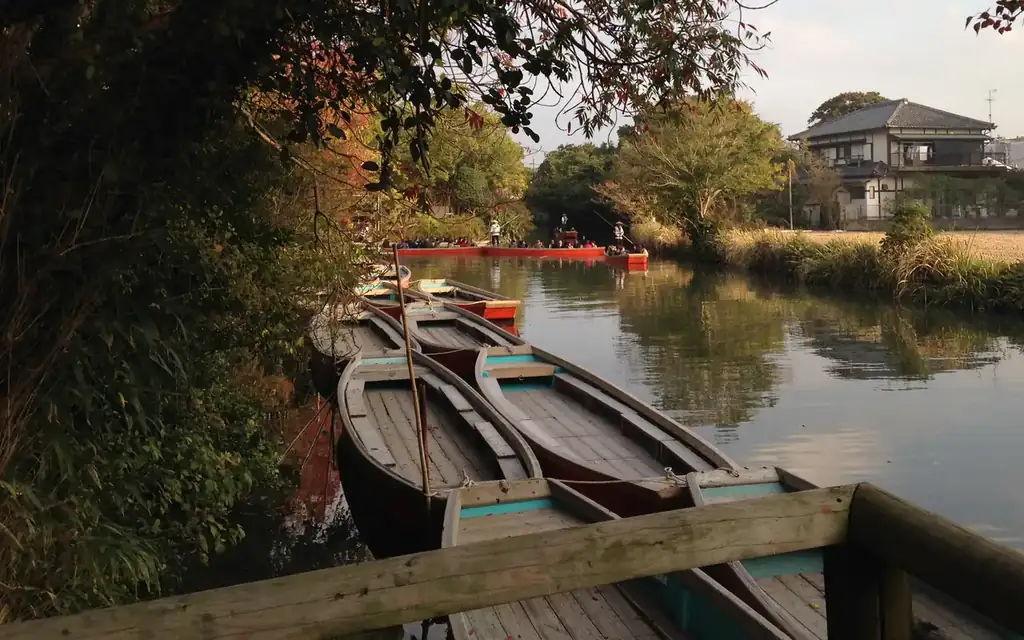
Wooden boats moored along a Yanagawa canalYanagawa, Fukuoka

Wooden boats moored along a Yanagawa canal

Yanagawa Canal Boat Ride

A boatman poles and sings you beneath the willows.

Getting there●○○○○Very easy on your own: about 50 minutes by Nishitetsu limited express from Tenjin, Fukuoka.

Best timeGood all year

Spend half a day out of Fukuoka for a boat ride in Yanagawa.

The bamboo pole dips softly into the water, the wooden boat glides beneath the willows, and the boatman starts to sing as he poles. Yanagawa is a castle town surrounded by water, and its web of canals, called horiwari, dates back to the Edo period. On a kawakudari ride you drift past stone walls and old houses. In winter the boats have kotatsu heated tables, so your feet stay warm while the banks slowly slide by. The photo shows Yanagawa's canals. It's also the hometown of the poet Kitahara Hakushu; back on shore, try unagi no seiromushi, eel steamed together with rice, rising with steam and the smell of sweet sauce. In mid-to-late April, the giant wisteria at Nakayama is well worth a detour. In Yanagawa, the best speed is the boatman's.

GETTING THEREAbout 50 minutes from Fukuoka's Tenjin on the Nishitetsu limited express to Nishitetsu-Yanagawa Station, then walk or take a shuttle to the boarding point.
GOOD TO KNOWRides run all year, but the kotatsu boats from December to February are the cosiest — warm feet while the banks glide by. A ride takes about an hour. Several operators run it with different start and end points, so you'll walk or ride back. Check the operator's site before you go.
SAFETYThe boat rocks when getting on and off — hold the side and move slowly. Don't stand up while moving, and duck under low bridges.
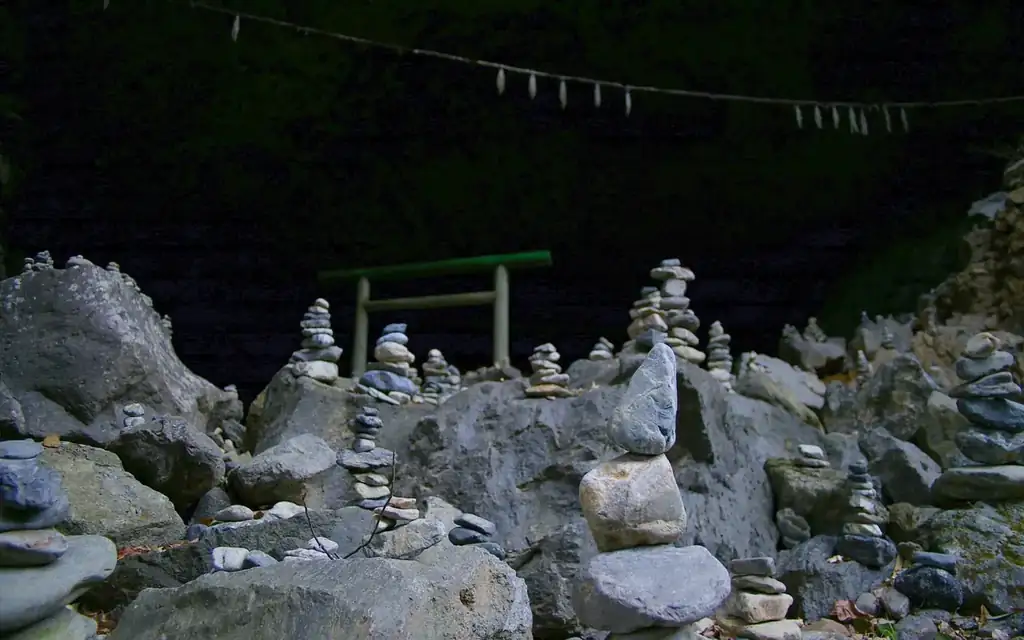
Stacked stone cairns and a torii in the Amano-Yasukawara caveTakachiho, Miyazaki

Stacked stone cairns and a torii in the Amano-Yasukawara cave

Amanoiwato and Amano-Yasukawara

The riverbank where the gods met, now piled with wishes.

Getting there●●●●○Harder: first get to Takachiho (about 3 hours by bus from Kumamoto or Fukuoka), then about 15 minutes by infrequent bus or taxi.

Best timeGood all year

When you're in Takachiho, spend a morning walking into a cave from mythology.

Follow the path down the gorge as the sound of the river grows louder, round a bend, and a huge cave opens in front of you: a sacred rope and torii at its mouth, and inside, stone cairns stacked one upon another as far as you can see. In Japanese mythology, the sun goddess Amaterasu hid in a cave called Amanoiwato and the world went dark, so eight million gods gathered on a riverbank to plan how to coax her out; that riverbank is said to be Amano-Yasukawara. Inside the cave the light dims and all that's left is the sound of water, and the myth starts to feel real. Nearby, the West Shrine of Amanoiwato Shrine treats the cave itself as its sacred object; it can't be photographed, and you can only bow toward it from a distance on a priest-led tour. Photography is prohibited at the worship area. Where the gods once met, add a small stone of your own.

GETTING THEREAbout 15 minutes by bus or taxi from the Takachiho bus center to Amanoiwato Shrine, then about 10 minutes along the riverside path from the West Shrine to Amano-Yasukawara. Buses are rare; pair it with Takachiho Gorge on the same day.
GOOD TO KNOWMornings are quietest, when the riverbed is at its most peaceful. Guided viewings of the cave run several times a day, led by priests — free, no booking, and no photos at the viewing spot. The stone stacks in the riverbed are visitors' prayers, so please don't knock them over.
SAFETYThe path to Amano-Yasukawara runs along the river with steps and slippery stones — take extra care in and after rain.
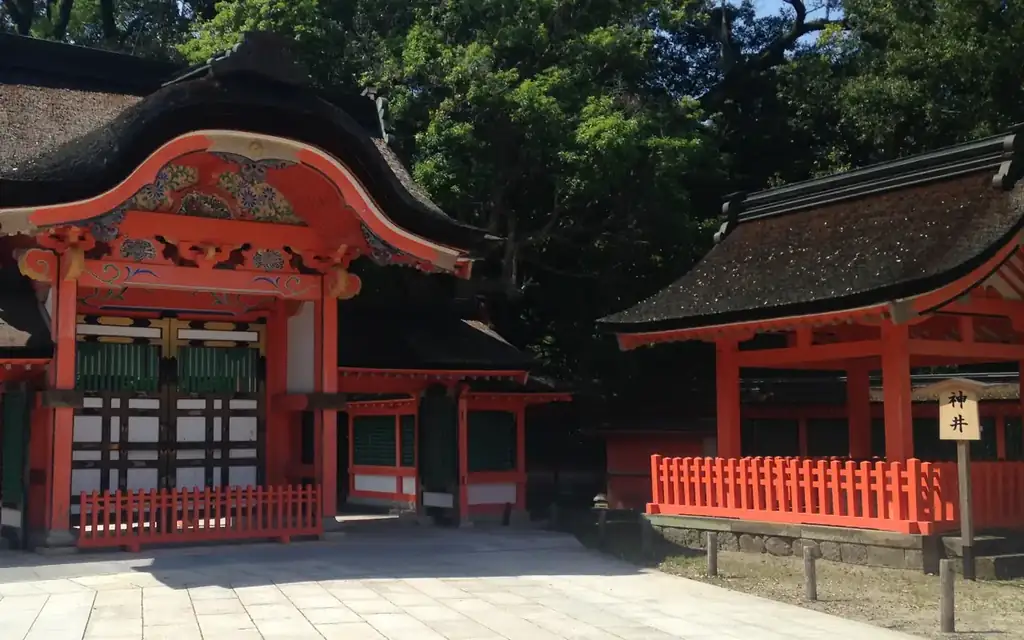
The vermilion halls of Usa JinguUsa, Oita

The vermilion halls of Usa Jingu

Usa Jingu

Here, you clap four times.

Getting there●●○○○Easy on your own: about 40 minutes by JR limited express from Beppu, then about 10 minutes by bus.

Best timeGood all year

When you're in Beppu, ride a little farther to Usa Jingu.

Walk into a great forest, birdsong falling from the treetops, and vermilion buildings slowly appear between the leaves. Usa Jingu is the head shrine of the more than 40,000 Hachiman shrines across Japan, with over a thousand years of history; its main sanctuary, a National Treasure of vermilion buildings with cypress-bark roofs, sits quietly in the woods. When you stand before the gods, remember the rule here is different: instead of the usual two bows, two claps, one bow, it's two bows, four claps, one bow, and the four crisp claps echo through the forest. The photo shows the West Great Gate of the upper shrine; the wooden sign on the right reads “sacred well.” At the source of over 40,000 Hachiman shrines, those four claps are how you truly pay your respects.

GETTING THEREAbout 40 minutes from Beppu by JR limited express to Usa Station, then about 10 minutes by bus. You can also drive from Oita Airport.
GOOD TO KNOWThe shrine is most serene in the morning, and autumn leaves are lovely. The grounds are large — allow 1 to 2 hours to walk the main approach to the upper shrine and round to the lower one. Remember it's four claps here, not two.
SAFETYThe upper shrine is on a small hill with many stone steps, slippery in the rain.
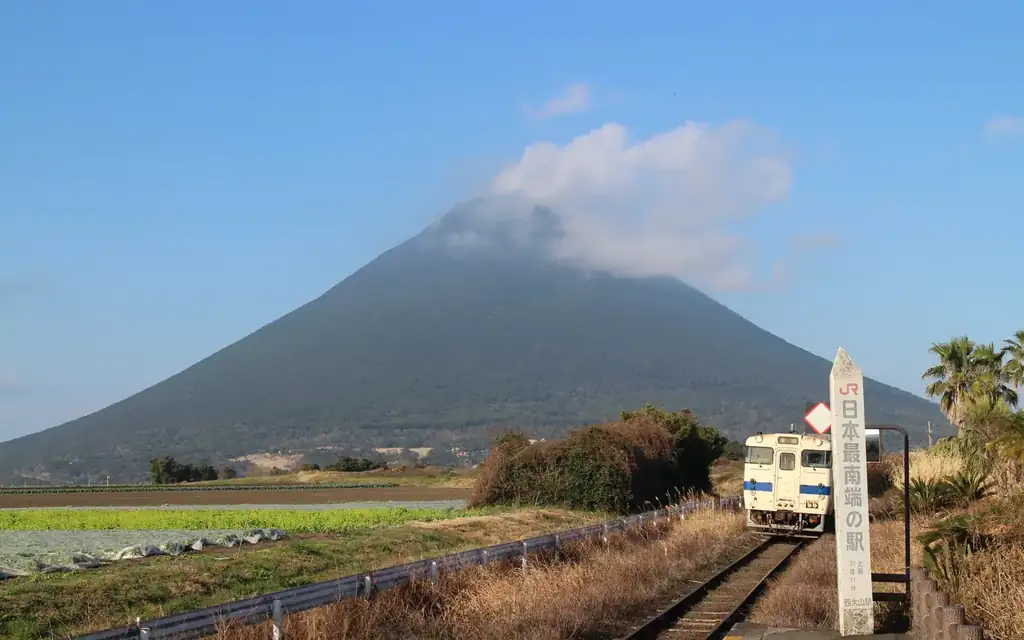
Nishi-Oyama Station's marker, a train and Mount Kaimon behindIbusuki, Kagoshima

Nishi-Oyama Station's marker, a train and Mount Kaimon behind

Nishi-Oyama Station, Ibusuki

Get buried in hot sand, then ride to Japan's southernmost station.

Getting there●●●○○Some planning: just over an hour by JR from Kagoshima-Chuo, but only a few trains a day run south of Ibusuki.

Best timeGood all year

When you're in Kagoshima, go a little farther south to the southernmost JR station in Japan.

Lie down on the beach while staff shovel sand warmed by geothermal hot springs over you, the sound of waves in your ears as the weight and heat of the sand slowly wrap your whole body. Ibusuki, at the southern tip of the Satsuma Peninsula, is known above all for this sunamushi sand bath: change into a yukata, get warmed through under the sand, then rinse off and soak in the hot spring. Ride the JR line further south and you reach Nishi-Oyama Station, JR's southernmost station in Japan. Its platform has just one track and a marker post reading “Japan's southernmost station,” with Mount Kaimon, called the “Fuji of Satsuma,” rising behind it. Stand on that platform, rails on one side and mountain on the other, and you'll feel you've truly reached the end of a country.

GETTING THEREAbout 1 hour from Kagoshima-Chuo Station on the JR Ibusuki Makurazaki Line to Ibusuki, or by sightseeing limited express; Nishi-Oyama is about 20 minutes farther south. Only a few trains a day run south of Ibusuki — check the timetable before you go.
GOOD TO KNOWThe little yellow station with Mount Kaimon behind it looks best on a clear day. In the sand bath, about 10 minutes is enough — get up if you feel unwell. Plan your return train before heading to Nishi-Oyama; missing one can mean a long wait, so check the timetable.
SAFETYDrink water before and after the sand bath. If you have heart disease or high blood pressure, or are pregnant, ask the staff first.
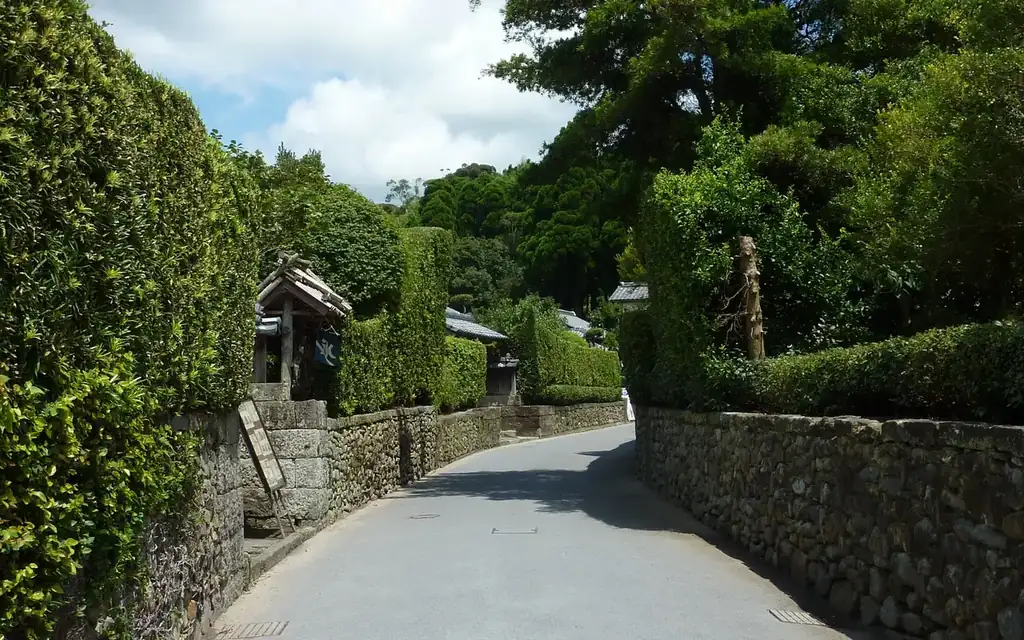
Clipped hedges and stone walls in Chiran's samurai districtMinamikyushu, Kagoshima

Clipped hedges and stone walls in Chiran's samurai district

Chiran Samurai Residences

Behind stone walls and hedges, gardens that borrow the mountains.

Getting there●●○○○Easy on your own: about 1 hour 20 minutes by bus from Kagoshima-Chuo Station.

Best timeGood all year

When you're in Kagoshima, spend half a day strolling Chiran's samurai district.

Stone walls stretch along the street, topped with neatly clipped hedges, and it's so quiet you can hear your own footsteps. Chiran was a samurai settlement of the Satsuma domain in the Edo period, known as the “Little Kyoto of Satsuma,” and the whole district is a national Preservation District for Groups of Traditional Buildings. Seven samurai gardens are open to visitors, all designated National Places of Scenic Beauty, and most are karesansui dry gardens that borrow the distant mountains as their backdrop; sit on the veranda for a while and your mind goes still. Nearby, the Chiran Peace Museum for Kamikaze Pilots records the special-attack pilots who took off from here at the end of World War II, and it's worth setting aside time to walk through it quietly. One morning, from samurai gardens to memories of peace, and Chiran leaves a deep mark on you.

GETTING THEREAbout 1 hour 20 minutes by bus from Kagoshima-Chuo Station to the “Bukeyashiki Iriguchi” stop, or about 1 hour by car.
GOOD TO KNOWSpring to early summer is when the gardens are greenest and most neatly clipped. One ticket covers all seven gardens along the street — allow about 1 to 1.5 hours. Check opening hours on the official site.
SAFETYSome gardens are still lived in — don't step into the gardens or onto the stones, and follow the visitor route.

Not sure which to pick? Take the 4-minute travel-personality quiz and find the one that suits you.

Take the quiz